Cold Laser Therapy vs. MLS Laser Therapy: Key Differences for Fishers Patients
Cold laser therapy is a non-invasive treatment that uses low-level red or near-infrared light to influence biological activity in tissue without making an incision or intentionally heating the area. MLS laser therapy works within the same broad field of photobiomodulation, but the Robotic M7 system used at Vital Connection Chiropractic is a Class IV, high-power, non-thermal device that synchronizes continuous 808 nm and pulsed 905 nm emissions. In practical terms, both approaches use therapeutic light, but they are not the same device, dose, power class, or delivery method. Patients comparing options can review MLS laser therapy in Fishers, IN and ask which technology is actually being recommended for their needs.
![]() What Is Cold Laser Therapy?
What Is Cold Laser Therapy?
Cold laser therapy is a common name for low-level laser therapy, often shortened to LLLT. You may also hear it called low-level light therapy or photobiomodulation. A clinician places or moves a laser applicator near the area being treated so that a selected dose of light reaches the tissue.
The word “cold” can be confusing. It does not mean that the device makes the skin cold. It separates this treatment from surgical or ablative lasers that intentionally cut, vaporize, or heat tissue. Most low-level systems should not create significant tissue heating when used correctly.
“Cold laser” is a broad marketing term, not one universal machine or protocol. Clinics may use devices with different wavelengths, power outputs, pulse patterns, applicators, and treatment times.
That variation is why the device name and planned dose matter more than the label. A useful consultation should explain the system, its cleared uses, why it may fit the problem being evaluated, and how progress will be measured.
 What Is MLS Laser Therapy?
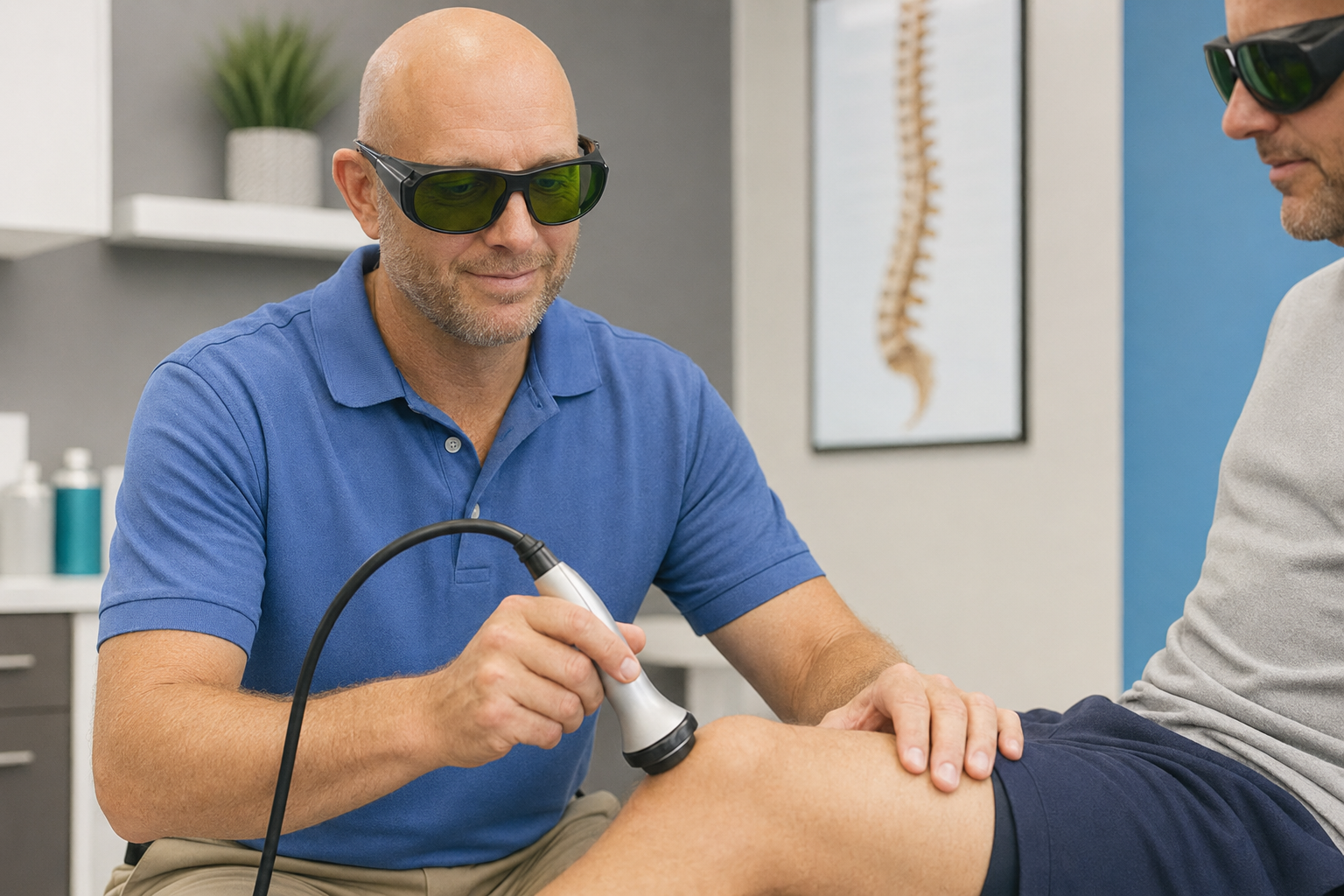 What Is MLS Laser Therapy?
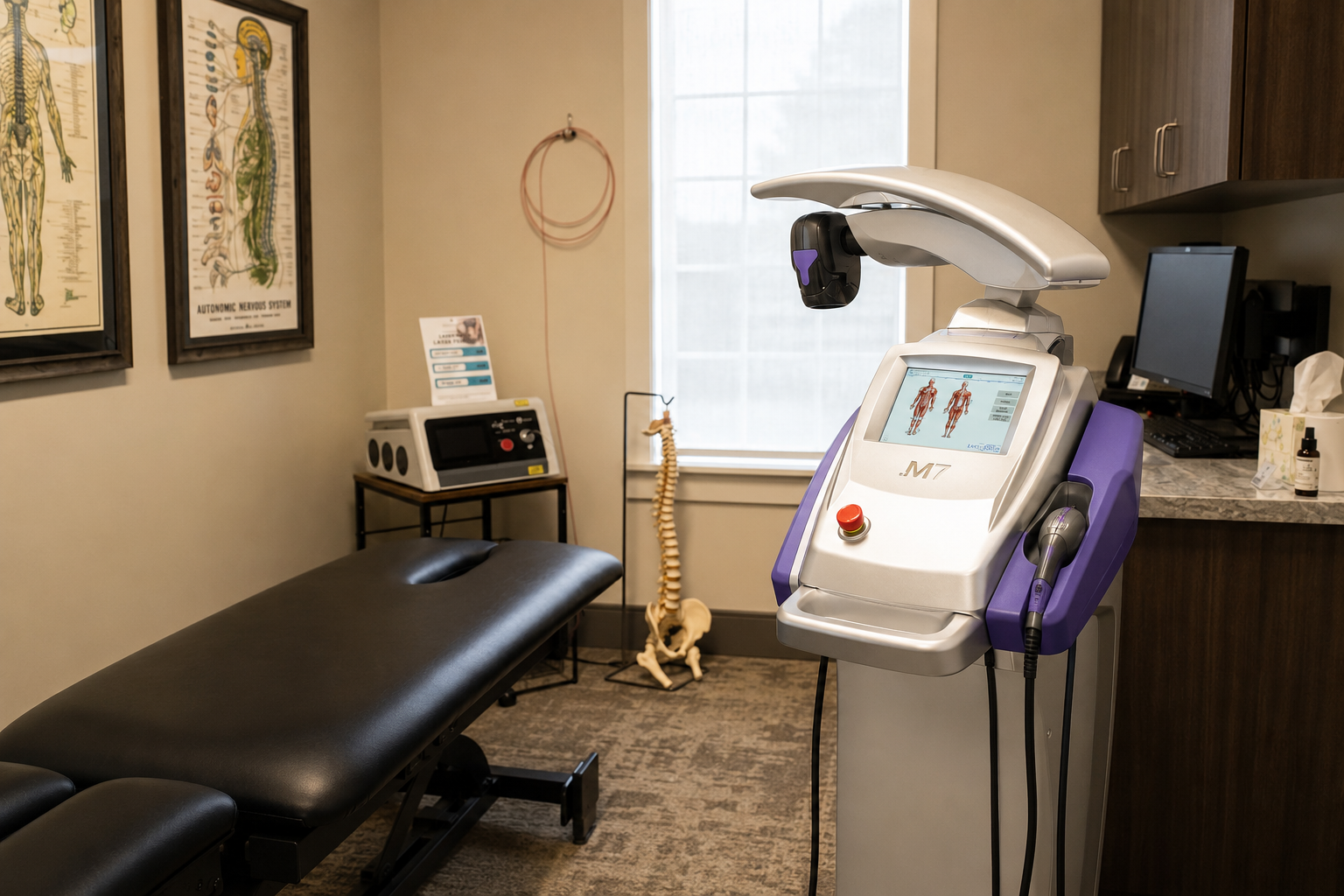
MLS stands for Multiwave Locked System. Instead of relying on one emission pattern, the technology synchronizes two infrared emissions. Vital Connection Chiropractic uses the Robotic M7 MLS Therapy Laser, which combines a continuous 808 nm emission with a pulsed 905 nm emission.
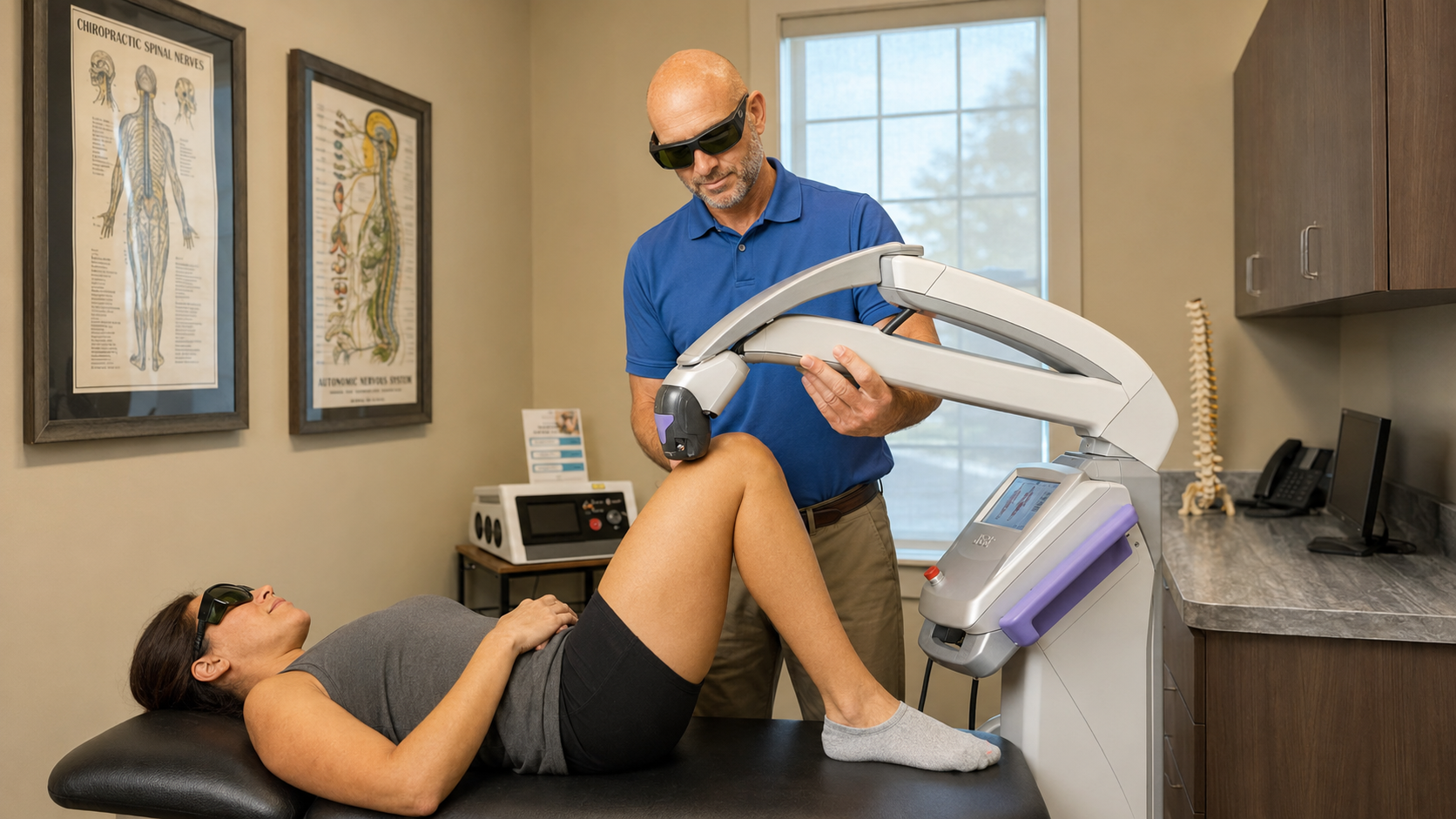
The M7’s robotic scanning head moves over a defined area, while its handheld applicator can be used for smaller or more focused treatment points. Its software calculates treatment time and energy delivery from the selected settings.
The manufacturer classifies the M7 as a Class IV, high-power, non-thermal therapeutic laser. “Class IV” is a laser safety classification. It indicates that careful controls, training, and protective eyewear are necessary. It does not, by itself, prove that a treatment will work better for a particular person than a lower-class device.
The M7’s FDA-cleared supportive indications include temporary relief of muscle and joint pain and stiffness, arthritis pain, and muscle spasms. They also include temporarily increasing local circulation and promoting muscle relaxation. FDA clearance is not a guarantee or cure.
Patients can review Vital Connection’s Robotic M7 MLS Therapy Laser service. Knowing the actual device is more useful than comparing broad phrases such as “advanced laser.”
Cold Laser Therapy vs. MLS Laser Therapy
 Cold Laser Therapy vs. MLS Laser Therapy
The simplest distinction is that cold laser therapy usually refers to lower-level devices, while the M7 is a specific high-power Class IV system with synchronized wavelengths and robotic or handheld delivery. The comparison is not absolute because cold laser devices vary widely.
| Feature | Cold Laser Therapy / LLLT | Robotic M7 MLS Therapy |
| Basic category | Broad term for lower-level photobiomodulation devices | A specific Multiwave Locked System device |
| Laser class and power | Often lower-power and commonly Class 3B, but the device label must be checked | Class IV, high-power, non-thermal according to the manufacturer |
| Wavelengths | Vary by manufacturer and intended use | Continuous 808 nm and pulsed 905 nm emissions |
| Emission pattern | Continuous, pulsed, or another device-specific pattern | Synchronized continuous and pulsed emissions |
| Delivery | Commonly a handheld probe, cluster applicator, or stationary panel | Robotic scanning head plus a focused handpiece |
| Treatment area | Often applied point by point or over a smaller region | Can scan a defined area or target selected points |
| Typical treatment time | Often several minutes, but can vary considerably by device, dose, and area | Commonly about 5 to 15 minutes for treatment, depending on settings and area |
| Safety needs | Eye protection and device-specific precautions still matter | Class IV controls, trained operation, screening, and protective eyewear are required |
| Best interpretation | The exact device and protocol determine what “cold laser” means | The device, wavelengths, delivery options, and cleared uses are identifiable |
Neither option is automatically better for every problem. Higher power can deliver a selected dose over an area more efficiently, but diagnosis, wavelength, dose, technique, and response still matter. A lower-level protocol may fit one situation, while the M7’s scanning head or handpiece may fit another.
Does Laser Therapy Actually Work?
Laser therapy may help some patients with certain musculoskeletal concerns, but evidence is condition-specific and not fully consistent. Reviews have reported possible improvements in pain or function for knee osteoarthritis, some neck pain, tendinopathy, and other muscle or joint problems. Other reviews have found uncertain benefit for particular conditions or protocols.
Studies use different wavelengths, power levels, doses, schedules, and outcome measures. A result from one device cannot automatically be applied to every cold laser or Class IV system.
A realistic goal is temporary symptom relief or improved function, not a cure. Progress might mean walking farther, using stairs more comfortably, sleeping better, or returning to an activity with less limitation. If meaningful improvement is not occurring, the plan should be reconsidered.
Laser therapy should fit the diagnosis. An irritated muscle or joint is approached differently from a fracture, infection, progressive nerve problem, or another medical condition. A machine cannot replace an evaluation.
Why the Treatment Details Matter
When someone asks whether MLS laser is better than cold laser therapy, the honest response is that the label alone cannot answer the question. Five details help make the comparison useful.
1. Wavelength
Cold laser devices may use red light, near-infrared light, or a combination. The M7 uses defined 808 nm and 905 nm infrared emissions. A provider should identify the wavelengths, not describe a device only as “powerful.”
2. Dose
Dose reflects the energy delivered to a defined area. More is not automatically better. Settings should follow device guidance and the clinician’s assessment.
3. Power and delivery time
A higher-powered system can deliver a planned dose differently or over a larger area, affecting efficiency and session length. Power class alone does not establish clinical quality.
4. Coverage and precision
A handheld probe can focus on a small point, while a robotic head can scan a selected region. The M7 offers both options.
5. Diagnosis and functional goal
The same sore knee can have several causes. The provider should consider how it started, what is limited, whether warning signs exist, and what improvement matters to the patient.
What to Expect During a Laser Treatment
A professional visit should begin with a conversation and examination, not with the machine. The provider may ask how symptoms began, what changes them, what has been tried, and which activities are affected.
If laser therapy is appropriate, the area is positioned safely and everyone in the treatment space wears protective eyewear. The clinician selects the settings and checks comfort during the session.
Cold laser treatment may involve moving a probe over several points. With the M7, the robotic head can scan an area or the handpiece can provide focused application. There is no incision or injection, and many people report little sensation.
There is usually no recovery period from an incision or anesthesia. One visit should not prove success or failure. Set a review point and assess measurable changes.
Safety and Possible Side Effects
Low-level laser therapy is generally well tolerated when used correctly, but “non-invasive” does not mean risk-free. Short-lived effects can include mild redness, warmth, tingling, tenderness, or a temporary change in symptoms. Report unexpected discomfort promptly.
The eyes require special protection. Direct or reflected laser energy can cause injury, particularly with higher-power equipment. Protective eyewear is not optional simply because the treatment is called cold or non-thermal.
A safety screening should consider health history, treatment location, light-sensitive medications or conditions, pregnancy, active cancer or an unexplained lesion near the area, and recent procedures. Patients should share complete information and follow device-specific guidance.
Laser therapy should not delay urgent evaluation. New or worsening weakness, spreading numbness, loss of bowel or bladder control, saddle numbness, fever with a hot swollen joint, a suspected fracture, stroke-like symptoms, or severe pain after major trauma need prompt medical attention.
Cost and Insurance Coverage
There is no universal price for cold laser therapy. U.S. estimates often fall around $50 to $150 per session, while broader published ranges run from about $30 to $200. Device type, location, treatment area, visit length, and packages affect the amount.
Insurance coverage is inconsistent. Medicare generally does not pay for low-level or cold laser therapy, and many private plans classify it as non-covered or investigational. Verify benefits directly because FDA clearance does not guarantee coverage.
Before beginning a series, ask about the per-session price, expected number of visits, package terms, payment options, and reassessment point. Confirm current Vital Connection fees before care begins.
How to Compare Laser Therapy Providers
Compare providers by how clearly they explain the equipment, safety process, recommendation, and follow-up plan, not by who claims to have the strongest laser.
| Question to Ask | Why It Matters | What a Clear Answer Should Include |
| What is the exact device and laser class? | “Cold laser” can describe many different systems | Manufacturer, model, class, and intended clinical use |
| Which wavelengths and delivery method are used? | These details help distinguish one protocol from another | Wavelengths, pulse pattern, scanning head, probe, or panel |
| Why might this fit my condition? | A symptom name alone is not a diagnosis | Examination findings, goals, limits, and alternatives |
| What result will we measure? | Pain scores alone may miss meaningful function | A specific activity, range of motion, sleep, walking, work, or training goal |
| When will the plan be reviewed? | Repeating treatment without progress is not patient-centered | A defined reassessment point and criteria for changing course |
| What are the safety steps? | Every medical laser requires appropriate precautions | Screening, eyewear, trained operation, and device-specific controls |
| What will the full plan cost? | Multiple sessions can create a meaningful total expense | Per-visit cost, package terms, expected range of visits, and payment policies |
Pause if a provider cannot name the device, promises a cure, guarantees tissue regeneration, or recommends a large package before understanding the problem. A trustworthy discussion includes limits and when other care may be appropriate.
Cold Laser and MLS Laser Therapy in Fishers, IN
Vital Connection Chiropractic uses the genuine Robotic M7 MLS Therapy Laser at its East 116th Street clinic in Fishers. The team begins with the patient’s symptoms, health history, examination findings, goals, and safety considerations.
For people coming from Fishers, Geist, Noblesville, Carmel, McCordsville, Castleton, or elsewhere in Hamilton County, a recommended schedule should be realistic for travel, work, family responsibilities, and total cost.
If you are unsure whether your concern is a reasonable fit, you can schedule a focused evaluation or contact Vital Connection Chiropractic with questions about the M7, visit expectations, and current pricing.
Frequently Asked Questions
 Frequently Asked Questions
Does cold laser therapy actually work?
Cold laser therapy may help with pain or function in some conditions, but it does not work equally well for every person or diagnosis. Research results vary because studies use different devices, wavelengths, doses, schedules, and comparison treatments. Evidence is more encouraging for certain musculoskeletal concerns than for others. A provider should explain the intended goal, use an appropriate protocol, and reassess whether the treatment is producing a meaningful change.
What are the negative side effects of cold laser therapy?
Side effects are usually mild when low-level laser therapy is delivered correctly, but risks still exist. Some people may notice temporary redness, warmth, tingling, tenderness, or a short-lived change in symptoms. Eye exposure is a preventable hazard, so wavelength-appropriate protective eyewear is essential. Tell the provider about pregnancy, light-sensitive conditions or medications, active cancer, unexplained lesions, and recent procedures before treatment.
Will insurance pay for cold laser therapy?
Many insurance plans do not cover cold laser therapy, although policies vary. Medicare generally treats low-level or cold laser therapy as non-covered, and some private insurers classify it as investigational. Do not assume that FDA clearance guarantees reimbursement. Ask the clinic for the billing description and expected self-pay amount, then confirm coverage, exclusions, deductibles, and documentation requirements directly with your insurer.
What is the average cost of cold laser therapy?
A commonly cited U.S. estimate is about $50 to $150 per session, but there is no fixed national price. Fees can be lower or higher depending on the device, location, treatment area, visit length, and whether sessions are purchased individually or as a package. Ask for the total estimated course, not only the per-visit amount. Vital Connection should be contacted directly for current M7 pricing and terms.
What are two drawbacks of laser therapy?
Two practical drawbacks are uncertain individual response and possible out-of-pocket cost. Evidence and results vary by condition and protocol, so even a well-selected treatment cannot be guaranteed. Insurance may not cover the service, and a recommended series can become a meaningful expense. Laser therapy also requires proper screening and eye protection, and it should not replace needed diagnostic testing, rehabilitation, or medical care.
How long does a cold laser treatment last?
A cold laser treatment often lasts several minutes, commonly around 5 to 20 minutes, but the actual time can be shorter or longer. It depends on the device’s power, the dose, the size and number of areas, and whether treatment is delivered point by point or across a broader region. Ask the provider how long the treatment portion and the full appointment will take.
Choosing the Right Laser Therapy Conversation
Cold laser therapy and MLS laser therapy share the broad principle of photobiomodulation, but the terms should not be treated as interchangeable. Cold laser usually refers to lower-level devices that vary widely. Vital Connection’s M7 is a specific Class IV, high-power, non-thermal system with synchronized 808 nm and 905 nm emissions, a robotic scanning head, and a focused handpiece.
The right choice depends on the suspected cause, treatment goal, device and dose, safety, cost, and honest progress reviews. Fishers-area patients can request a laser therapy appointment with Vital Connection Chiropractic.