What Is Class 4 Laser Therapy?
Class 4 laser therapy is a form of medical laser therapy that uses higher-output red and near-infrared light to deliver a carefully selected dose of energy to targeted tissue. The class number is mainly a safety classification based on the laser’s potential to injure the eyes or skin, not a quality score. In trained clinical use, Class IV laser therapy may support pain management, circulation, and tissue-repair processes for selected musculoskeletal concerns. Treatment is noninvasive, often feels gently warm, and requires protective eyewear and precise dosing.
For patients in Fishers, the practical question is not simply whether a laser is Class 4. It is whether the device, wavelength, dose, treatment area, and clinical plan fit the reason you are seeking care. Vital Connection Chiropractic offers MLS laser therapy in Fishers, IN for patients who want to discuss whether laser treatment may be an appropriate part of an individualized care plan.

![]() What Does “Class 4” Mean in Laser Therapy?
What Does “Class 4” Mean in Laser Therapy?
“Class 4” describes a laser safety category based partly on accessible power and the potential for eye or skin injury. The supplied research describes Class 3B therapeutic lasers as operating from 5 to 500 milliwatts and Class 4 lasers above 500 milliwatts. These higher-output devices require trained operation and strict eye protection.
A higher class does not automatically mean a better treatment. A Class 4 device can deliver more energy in less time and may improve light transmission into deeper musculoskeletal tissues. It can also heat superficial tissue if used incorrectly. Clinical value depends on wavelength, output, duty cycle, applicator movement, treatment time, and total dose.
A thoughtful provider should therefore be able to explain why a particular setting is being used. The goal is not to turn the machine to its highest level. The goal is to deliver an appropriate amount of energy to the intended tissue while protecting the patient.
How Does Class IV Laser Therapy Work?
Class IV laser therapy works through photobiomodulation. Red and near-infrared light enters tissue and is absorbed by light-sensitive components within cells. This interaction can influence cellular activity, including production of adenosine triphosphate, or ATP, which supplies energy for normal cellular processes.
The uploaded materials also describe effects involving cell metabolism, collagen synthesis, circulation, and tissue repair. These possible biological responses do not promise faster healing or immediate relief. Response can vary with the condition, tissue depth, timing, and dose.
A Class 4 laser can deliver more photonic energy during a shorter session than a lower-power device. This may be useful for a larger area or deeper structures such as muscles, ligaments, tendons, joints, or cartilage. Output alone is not enough. Wavelength affects absorption and transmission, while treatment time and duty cycle influence total energy.
This is why medical laser therapy should be viewed as a dosed clinical modality rather than a bright light placed over any painful spot. More power is not automatically more therapeutic.
What Does the Research Say About Class 4 Laser Treatment?
One supplied controlled crossover study illustrates the importance of dose. Researchers treated the biceps area of ten healthy college-aged men using sham, 1-watt, 3-watt, and 6-watt protocols. Each session lasted four minutes, with forearm blood flow measured during and after treatment.
The 3-watt protocol, delivered at a 50 percent duty cycle for a total of 360 joules, was the only tested dose that produced a statistically significant increase from baseline. The increase appeared near the end of treatment and lasted for about two minutes afterward. The sham, 1-watt, and 6-watt protocols did not produce the same measured change.
That finding does not prove that 3 watts is correct for every body area or condition. The study involved only ten healthy young men, not a clinical pain population. It measured short-term blood flow rather than long-term pain, function, or healing and tested one muscle area with one protocol.
The practical lesson is that response can be dose dependent. A setting may be too low, while a higher setting can also miss the desired effect. Appropriate dosing matters more than the largest number on the device.
 Class 3B vs. Class 4 Laser Therapy
 Class 3B vs. Class 4 Laser Therapy
Class 3B and Class 4 therapeutic lasers use light to influence biological activity, but they differ in output, energy-delivery speed, heat potential, and safety controls. “Cold laser” commonly refers to lower-level devices that do not create a noticeable thermal effect in superficial tissue.
| Feature | Class 3B or Cold Laser | Class 4 Laser | Why It Matters |
| Typical output described in the supplied research | 5 to 500 milliwatts | More than 500 milliwatts | Class 4 can deliver more energy in less time |
| Sensation | Usually little or no warmth | May create gentle warmth | Patient comfort and tissue sensitivity affect device choice |
| Tissue application | Often used for superficial, smaller, or delicate areas | May be selected for larger or deeper musculoskeletal targets | Tissue depth is one factor in treatment planning |
| Session efficiency | Lower output may require longer exposure | Higher output can shorten energy-delivery time | Faster is useful only when the dose remains appropriate |
| Safety needs | Eye protection and trained use remain important | Strict eye protection, training, and controlled technique are essential | Higher output increases the consequences of incorrect use |
Neither column is universally better. A lower-power approach may suit delicate nerves, wounds, smaller joints, or sensitive areas. Class 4 may efficiently treat deeper or larger targets. Patients should be cautious of any explanation that uses the class number as the only reason to choose a device.
If you are comparing options locally, review the clinic’s medical laser therapy service and ask what type of laser is used, what the treatment is intended to address, and how progress is evaluated.
What Conditions May Be Considered for Medical Laser Therapy?
The supplied materials discuss laser therapy for concerns such as joint pain, arthritis symptoms, back or neck pain, muscle strains, tendinitis, bursitis, plantar fasciitis, sports injuries, sprains, and post-surgical recovery. Some also mention sciatica, carpal tunnel syndrome, and neuropathy.
These lists show where clinicians may consider laser therapy. They do not prove that one device has the same evidence or expected outcome for every diagnosis. “Knee pain,” for example, can arise from different tissues and causes that need different plans.
The same caution applies to neuropathy. Numbness, tingling, burning, and altered sensation can have different causes. Laser therapy may be considered as an adjunct in some care plans, but the supplied materials do not establish Class 4 treatment as a cure for neuropathy or as a replacement for identifying and managing the underlying cause. New, progressive, or unexplained nerve symptoms deserve appropriate evaluation before symptom-focused treatment.
What Does Class 4 Laser Therapy Feel Like?
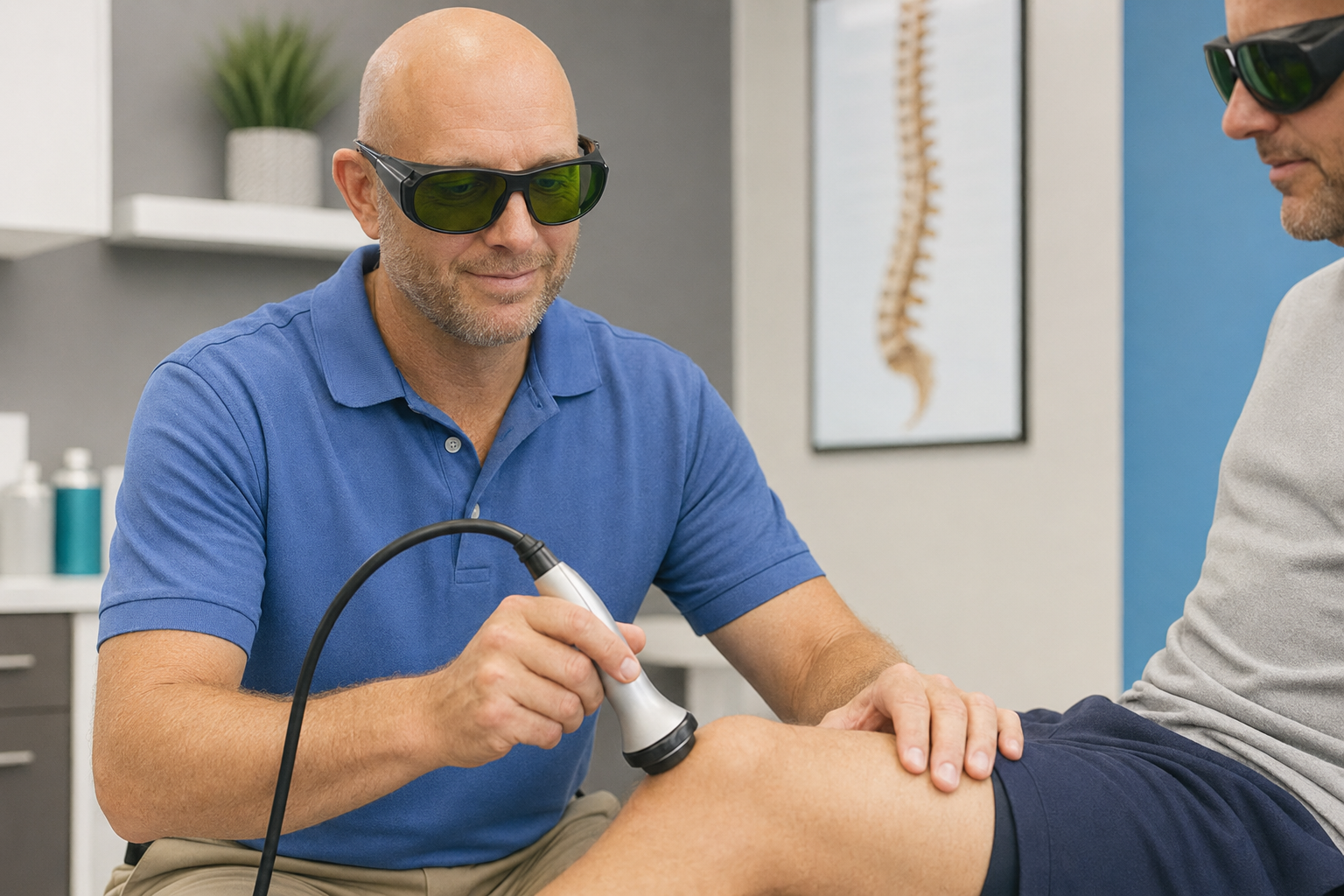
Class 4 laser treatment is generally described as comfortable and noninvasive. The applicator may touch the skin lightly or move just above it. Patients commonly notice mild warmth. Burning, sharp pain, or excessive heat should not be expected.
Session length varies by treatment area and protocol. The supplied materials describe applications from a few minutes to around 20 minutes. One overview mentions approximately 6 to 10 sessions, but the number and timing of visits should depend on the condition, goals, and response.
| Stage | What Usually Happens | What You May Notice | A Useful Question to Ask |
| Assessment | The clinician reviews the concern, treatment area, health history, and relevant sensitivities | Discussion and examination before treatment | What is the treatment intended to address? |
| Preparation | Skin access and device settings are prepared; everyone in the controlled area uses protective eyewear | A calm setup with no downtime required | Why were these settings selected? |
| Application | The applicator is moved across or held near the target area according to the protocol | Mild warmth or little sensation | What should I feel, and what should I report? |
| Reassessment | Comfort, motion, function, or another relevant measure may be checked | Changes may be immediate, gradual, or absent | How will we judge whether treatment is helping? |
| Follow-up plan | The clinician decides whether to continue, adjust, combine, or stop care | Recommendations should reflect your response | When will the plan be reviewed? |
Before a visit, tell the provider about medications, health conditions, light sensitivity, sensitive skin or eyes, and any change in symptoms. The clinic’s MLS laser therapy information can help you prepare questions, but it cannot replace an individual assessment.
Potential Benefits, Limitations, and Safety
 Potential Benefits, Limitations, and Safety
Potential benefits described in the supplied materials include support for pain relief, temporary reduction of arthritis symptoms, muscle relaxation, circulation, range of motion, and tissue-repair processes. Treatment is drug-free, noninvasive, and may accompany rehabilitation or other care.
Evidence and response are condition specific. A biological effect measured in a small laboratory study does not guarantee a meaningful clinical outcome. Dose, wavelength, tissue depth, timing, and technique can change the result, and some patients may notice little or no benefit.
Higher output requires greater safety control. Protective eyewear is essential because direct or reflected light can damage the eyes. The provider must manage movement, exposure time, duty cycle, and distance to avoid excessive heating. Discuss medications, health conditions, skin or eye sensitivity, and light sensitivity before treatment.
Laser therapy should not be applied casually over any painful or suspicious area. One source advises against use over cancerous lesions, over the abdomen during pregnancy, and in people with uncontrolled bleeding disorders. Individual medical circumstances matter, so screening and provider oversight are part of the treatment, not optional extras.
Class IV Laser Therapy vs. Red Light Therapy
Class IV laser therapy and red light therapy both use light, but the labels can describe very different devices. Class IV treatment uses a higher-output, focused clinical laser with controlled settings and mandatory eye protection. “Red light therapy” may refer to a lower-level laser or a broader LED device. Those options generally deliver energy differently and may be used for more superficial targets.
Class IV is not automatically better. It may deliver more energy in less time and may be chosen for deeper or larger musculoskeletal tissues. A lower-intensity approach may be more appropriate for delicate, superficial, or heat-sensitive areas. The right comparison should include wavelength, power, beam characteristics, treatment area, dose, and clinical objective, not just the words “laser” or “red light.”
This also explains why recommendations vary among doctors. A clinician may support light therapy for one condition and not recommend it for another because the diagnosis, evidence, device, dosing, and safety considerations differ.
Choosing Laser Therapy in Fishers, IN
Patients in Fishers and nearby Hamilton County communities such as Noblesville, Carmel, Geist, and McCordsville can benefit from asking grounded questions:
- What tissue or functional problem is the treatment meant to address?
- What will be measured before and after a trial of care?
- What safety screening and eyewear are required?
- How many sessions are proposed, and when will the plan be reviewed?
- What happens if symptoms do not improve?
A trustworthy conversation should leave room for uncertainty. Laser therapy may be useful as one part of a care plan, but it should not be presented as a guaranteed cure or a substitute for determining why symptoms are present.
Frequently Asked Questions
 Frequently Asked Questions
How much does class IV laser treatment cost?
Class IV laser treatment costs vary by clinic, treatment area, session length, and number of visits. The supplied materials do not establish a current price for Vital Connection Chiropractic, so quoting a dollar amount would be misleading. Ask whether pricing is per session or offered as a package and what the fee includes. For current local pricing, contact Vital Connection Chiropractic.
What is the difference between Class 3 and Class 4 laser therapy?
The primary difference is output and energy-delivery speed. The supplied research describes Class 3B lasers as operating from 5 to 500 milliwatts and Class 4 lasers above 500 milliwatts. Class 3B is often called cold or low-level laser therapy and usually produces no noticeable heat. Class 4 may create warmth, deliver a larger dose more quickly, and requires stricter safety controls. One is not automatically better.
Is class 4 laser therapy good for neuropathy?
It may be considered as an adjunct for some nerve-related symptoms, but it is not a proven cure for every type of neuropathy. The supplied materials mention neuropathy among potential applications, while another describes lower-level therapy for delicate or superficial nerves. The cause, location, and depth of the problem should be evaluated before choosing a device.
Is Class 4 laser therapy better than red light therapy?
Not in every situation. Class 4 lasers offer higher output and faster energy delivery, which may suit larger or deeper musculoskeletal targets. Lower-intensity red light or cold laser methods may suit superficial, delicate, or heat-sensitive areas. The best option depends on device, wavelength, dose, tissue depth, condition, and treatment goal.
What are two drawbacks of laser therapy?
Two drawbacks are the need for strict safety and dosing controls, and the uncertainty of individual results. First, higher-output devices require trained operation, protective eyewear, and careful management of heat and exposure. Second, the response depends on the condition and protocol, so multiple sessions may be proposed without a guarantee of meaningful improvement. A time-limited plan with clear reassessment criteria helps address that uncertainty.
Why don’t doctors recommend red light therapy?
Some doctors do recommend it, but not for every problem or device. “Red light therapy” covers many wavelengths, power levels, delivery methods, and consumer or clinical products. The supplied materials also note that mechanisms and effectiveness remain incompletely understood in some musculoskeletal applications. A doctor may decline when the diagnosis, evidence, dose, safety profile, or goal is unclear.
A Practical Next Step
Class 4 laser therapy is best understood as a higher-output, clinician-controlled form of photobiomodulation. Its practical advantages are efficient energy delivery and the potential to reach larger or deeper musculoskeletal targets. Its limits are equally important: the class number does not guarantee a better result, correct dose matters, evidence varies by condition, and eye protection and trained use are essential.
If you are considering Class IV laser therapy in Fishers, bring your questions and expect a clear explanation of the goal, safety process, proposed schedule, and method for measuring progress. You can schedule an appointment with Vital Connection Chiropractic to discuss whether laser therapy may fit your needs.