

IT Band Pain Relief: What Actually Helps (and What Doesn’t)
If you are in Fishers, IN and looking for it band pain relief, the fastest path is usually: calm the flare, stop irritating the outside of the knee with the wrong “fix,” then rebuild hip control so your stride stops re-triggering the problem.
Most outside-knee flares improve when you manage load, clean up mechanics, and strengthen the right tissues, not when you only stretch harder or roll more aggressively.
Around Hamilton County, this shows up a lot in runners, cyclists, lifters, and busy parents who do stairs, long walks, and weekend projects. The same pattern is common for people coming in from Noblesville, Geist Indianapolis, Castleton, Carmel, and McCordsville.
If you want a plan based on your pattern (instead of trial-and-error), you can Schedule an appointment.
 Quick “Do This First” Plan for Outside-Knee IT Band Flares ✅
Use this as your first 10 to 15 minutes when the outside of your knee feels hot, sharp, or “grabby.” The goal is to reduce irritation today, then set up the real fix (capacity + control) this week.
| Step | What to do | Time | Why it helps |
|---|---|---|---|
| 1 | De-load the trigger (skip hills/speed, shorten stride on stairs) | Today | Stops repeating the same compression/friction that keeps it angry |
| 2 | Ice the outside knee if it feels hot or reactive | 10–15 min | Calms flare symptoms so movement feels safer |
| 3 | Easy walk on flat ground (no limp) | 5–10 min | Restores motion and circulation without poking the sore spot |
| 4 | Gentle hip mobility (pain-free range only) | 2 min/side | Reduces “tugging” from stiff hips and overworked front/outer hip |
| 5 | Light glute activation (easy bridges or side-steps) | 1–2 min | Turns on stabilizers that protect the knee during single-leg loading |
If symptoms ramp up with any step, scale it down. If you are unsure what is safe for your case, book an evaluation instead of forcing it.
Start here if you want local guidance (hub + location + schedule)
Hub page for local knee care: Knee Pain Treatment in Fishers, IN
Related guide for stubborn knee patterns: knee pain relief in Fishers, IN
Main clinic location + hours: Contact the Fishers clinic
Ready now: Schedule an appointment
Helpful nearby location pages:
Geist Indianapolis and NE Indy patients typically use the Fishers clinic as the closest hub, then schedule based on availability.
What “IT band pain” usually is (and why it keeps coming back)
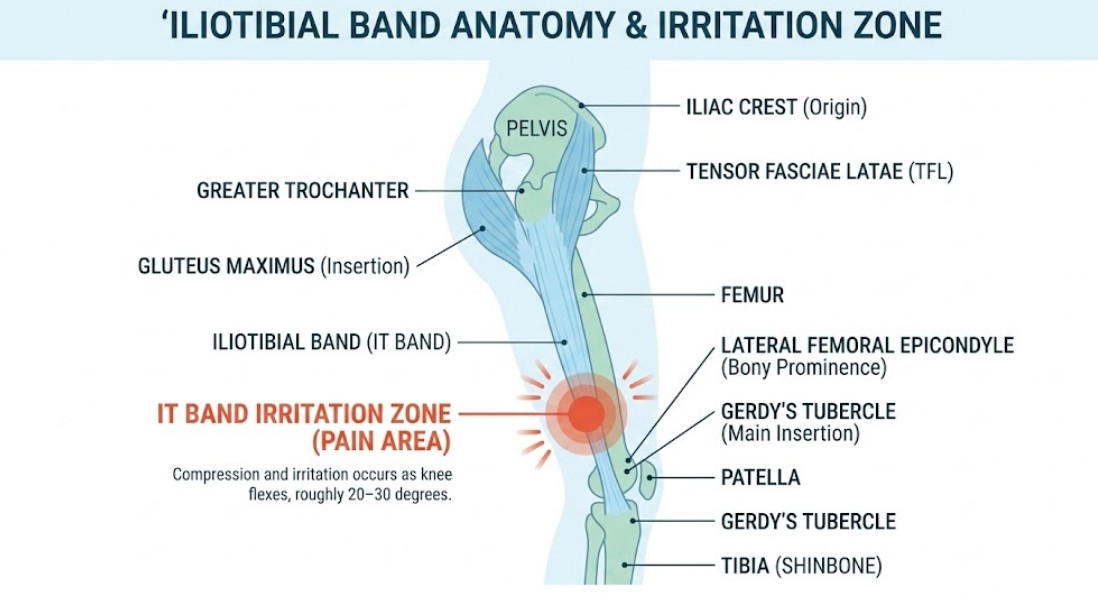
Most people describe this as lateral knee pain that shows up at a predictable time: near the end of a run, after hills, after a jump in mileage, or during stairs and squats. It can feel sharp, burning, or achy on the outside of the knee, and some people notice it creeping up the outside thigh toward the hip.
What makes it confusing is that the pain is felt at the knee, but the driver is often higher up the chain (hip control) plus the way the knee is being loaded repeatedly. That is why a “perfect stretch” can feel good for 20 minutes and then the pain returns the next run.
Why the outside of the knee gets sensitive
The IT band is a thick connective tissue structure that helps transfer force from the hip and thigh down toward the knee. In classic IT band syndrome patterns, the tissue and the structures underneath get irritated during repetitive knee bending and straightening, especially with downhill running, long runs, or sudden training changes.
The practical takeaway: you usually do not win by attacking the sore spot harder. You win by reducing the repeated trigger and improving how the hip and leg control single-leg landing.
 Myth-busting: what actually helps (and what doesn’t)
 Myth-busting: what actually helps (and what doesn’t)
A lot of popular IT band advice is not “wrong,” it is just incomplete. Here is the difference between short-term soothing and long-term change.
| Common advice people try | Why it feels helpful | When it backfires | What usually works better |
|---|---|---|---|
| Roll directly on the outside of the knee | It hurts-good and feels like you are “breaking it up” | Can spike irritation because you keep compressing the most sensitive area | Roll glutes, outer hip, quads instead; keep pressure off the painful knee zone |
| Stretch the “IT band” aggressively | Temporary relief, sensation of looseness | Often returns fast if hip control and load are unchanged | Use gentle mobility + build hip stability and leg capacity |
| Rest until it disappears | Symptoms may calm | You return to the same workload and it flares again | Modify load, then rebuild gradually (weekly progression beats random rest) |
| Only ice and anti-inflammatories | Can reduce pain early | Does not fix the driver | Use symptom tools plus strength + mechanics work |
| “It’s just tight, stretch more” | Simple story | Misses the real limiter: tolerance + control | Fix training errors, hip strength, cadence/stride, and recovery habits |
Which option is best for you (quick match)
-
If pain is sharp and localized at the outside knee, choose load modification + calm the flare first, then strength.
-
If pain shows up only after a specific trigger (hills, speed, long run), choose training edits + gradual return.
-
If you notice the knee collapses inward, your hips drop, or balance feels shaky, prioritize hip strengthening exercises and single-leg control.
-
If symptoms are not improving after a few weeks, or the diagnosis feels uncertain, get evaluated. Johns Hopkins notes clinicians often need to rule out other causes like meniscal injury or arthritis when the picture is not clear.
Foam rolling: how to do it without making it worse
Yes, foam rolling IT band related tissues can be useful, but the target matters. Cleveland Clinic lists foam roller use as a manual therapy option often taught by a physical therapist.
Here is the “works in real life” version:
✅ Aim the roller at glutes (especially the outer glute), TFL/outer hip, and front/outer thigh (quad)
✅ Use moderate pressure, slow passes, and keep breathing
✅ Spend 30–60 seconds per area, then get up and move (walk a minute)
What to avoid in a flare:
-
Long, heavy pressure directly on the most painful outside-knee point
-
Rolling so hard that you limp afterward (that is not a productive signal)
If you want a simple test: after rolling, your walking should feel easier, not worse.
 The “real fix”: build hip control so the knee stops taking the hit
 The “real fix”: build hip control so the knee stops taking the hit
Most stubborn outside-knee patterns improve when the hip can control the leg during single-leg loading. That is why so many successful plans emphasize hip abductor work, gradual return to running, and form tweaks as needed.
Three starter moves that usually translate fast (no fancy equipment)
Pick 2 and do them 3 days/week for 3–4 weeks:
-
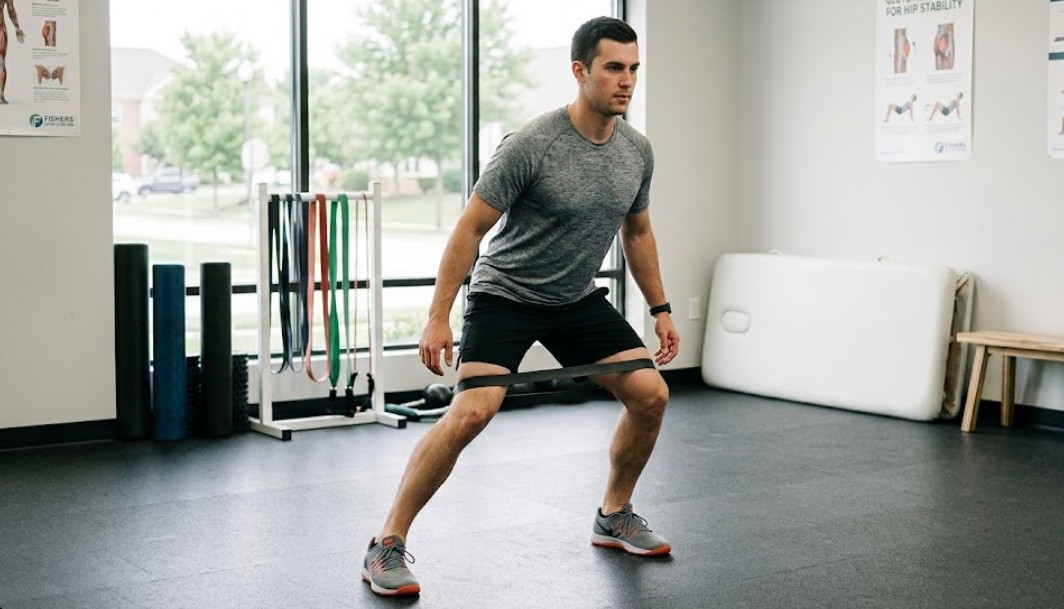
Side-steps with a mini-band (or no band at first)
Keep toes forward, knees soft, and do not let the hips sway. -
Supported step-downs
Use a handrail, move slowly, and keep the knee tracking over the middle toes. -
Bridge holds (glute focus)
Stop before hamstrings cramp. Make it smooth and controlled.
Practical tip: your goal is not to “feel it in the IT band.” Your goal is to feel a stable hip and a quieter knee during stairs, walking, and runs.
Running and daily-life tweaks that calm lateral knee pain faster
Small changes can reduce irritation while you build capacity:
-
Reduce hills and speed work for 7–14 days, then reintroduce one variable at a time. Downhills are a common provoker.
-
Shorten stride slightly and consider a small cadence increase if you tend to overstride (this often reduces braking forces).
-
If stairs are the trigger: go slower, use the handrail temporarily, and avoid deep, repetitive knee bends early.
This is not about “perfect form.” It is about lowering the repeated irritant long enough for strength to stick.
How long does it take to heal?
Most people want a number, but the better question is: “How consistently can I remove the trigger and rebuild tolerance?”
Cleveland Clinic reports that with nonsurgical treatment, many people improve in about 4–8 weeks (and some studies show 2–6 weeks).
In real life, the timeline is longer if:
-
you keep re-triggering it with hills, speed, or long runs
-
hip strength and single-leg control are clearly limited
-
sleep and recovery are poor (your tissue stays reactive)
If you are trending better week to week (stairs easier, longer walk before symptoms, run time increasing), you are on track.
When to get checked sooner (instead of guessing)
Get evaluated sooner if:
-
the pain is associated with a true “giving way,” locking, or major swelling
-
you had a clear trauma
-
symptoms are worsening despite 2–3 weeks of smart modifications
-
pain is not behaving like a typical overuse pattern, or you suspect another cause (Johns Hopkins notes clinicians may use imaging if diagnosis is unclear).
What care can look like in Fishers (and why it helps some people progress faster)
When outside-knee pain lingers, it is often because the plan is missing one of the big levers: movement screening, hip strength progression, or a step-by-step return to running.
Vital Connection Chiropractic’s knee care approach describes an exam-first process that looks beyond the knee, including hip strength, ankle mobility, foot posture, and possible low-back contribution, then pairs hands-on care with targeted rehab.
If you are ready to stop guessing and want a plan built around your pattern, Schedule an appointment.
 A better wrap-up (what to do next)
 A better wrap-up (what to do next)
The best results usually come from the right order: calm the flare, remove the repeat trigger, then rebuild capacity so your knee can tolerate real life again. If you want it band pain relief that lasts, aim for measurable weekly progress (stairs, walking time, run minutes, hill tolerance) instead of rotating random stretches.
And if you want the short version to remember: reduce hills and speed briefly, roll the hip not the sore knee, strengthen the glutes consistently, then return to running gradually.
FAQs
Should you massage a sore IT band?
Yes, but massage the right area, not the angriest knee spot. If your pain is focused at the outside knee, heavy pressure right on that point can flare symptoms because you are compressing an already sensitive region. A better strategy is to use massage or a roller on the glutes, outer hip, and outer thigh, then follow it with a short walk or gentle movement. If massage makes you limp or increases pain later that day, scale pressure down.
What can be mistaken for IT band syndrome?
Several conditions can mimic lateral knee pain, so pattern matters. Meniscus irritation, arthritis changes, and referred pain patterns can look similar, especially when symptoms are not tied to a predictable training trigger. Johns Hopkins notes clinicians often need to distinguish IT band syndrome from other causes of knee pain and may use imaging if the diagnosis is unclear. If your pain is locking, giving way, swelling significantly, or not behaving like an overuse issue, get assessed.
How long does it take for a IT band strain to heal?
Many cases improve within weeks, but the timeline depends on re-triggering and strength. Cleveland Clinic notes that many people improve with nonsurgical treatment in roughly 4–8 weeks (and sometimes 2–6 weeks). If you keep running hills, adding speed, or ignoring single-leg control, symptoms often linger. If you reduce the trigger, build hip strength 3 days/week, and return gradually, most people see clear week-to-week progress.
What not to do with IT band pain?
Do not keep poking the sore outside-knee point with aggressive rolling or “stretch through it” runs. Avoid repeating the exact trigger that caused the flare (downhills, speed work, sudden mileage spikes) for a short window, because that is how the irritation stays active. Also avoid making your entire plan only “rest and ice,” because that may calm symptoms but does not raise tolerance. Instead, modify load, keep easy motion, and rebuild hip control.
How do I get my IT band to stop hurting?
Stop the repeat trigger and rebuild the hip-to-knee chain. Start by reducing hills and speed for 7–14 days, then add consistent hip stability work and a gradual return plan. Many people also do well with targeted soft tissue work to the glutes and outer hip, then movement that reinforces control (step-downs, side-steps, balance). If you have tried this for a few weeks and progress is flat, an evaluation can pinpoint what is missing.
Is ice or heat better for IT band?
Ice is usually better in a fresh flare; heat can help when the area feels more tight than hot. If the outside knee feels warm, reactive, or sharp after activity, short ice sessions can calm symptoms so walking and rehab feel easier. If things feel stiff and guarded without that “hot” sensation, gentle heat to the hip and thigh may help you move more comfortably before doing mobility or strengthening. Either way, the long-term fix is still load management plus strength, not temperature alone.


