Posture Correction Exercises You Can Do at Home (Desk + Driving)
If you are in Fishers, IN and your neck feels “stacked forward” after work or your shoulders round during long drives, the fix is usually a simple mix of mobility plus endurance, not forcing one huge stretch. This page gives you a repeatable desk + driving routine you can do at home in under 10 minutes, plus clear guidance on what to change first so the tension does not rebuild.
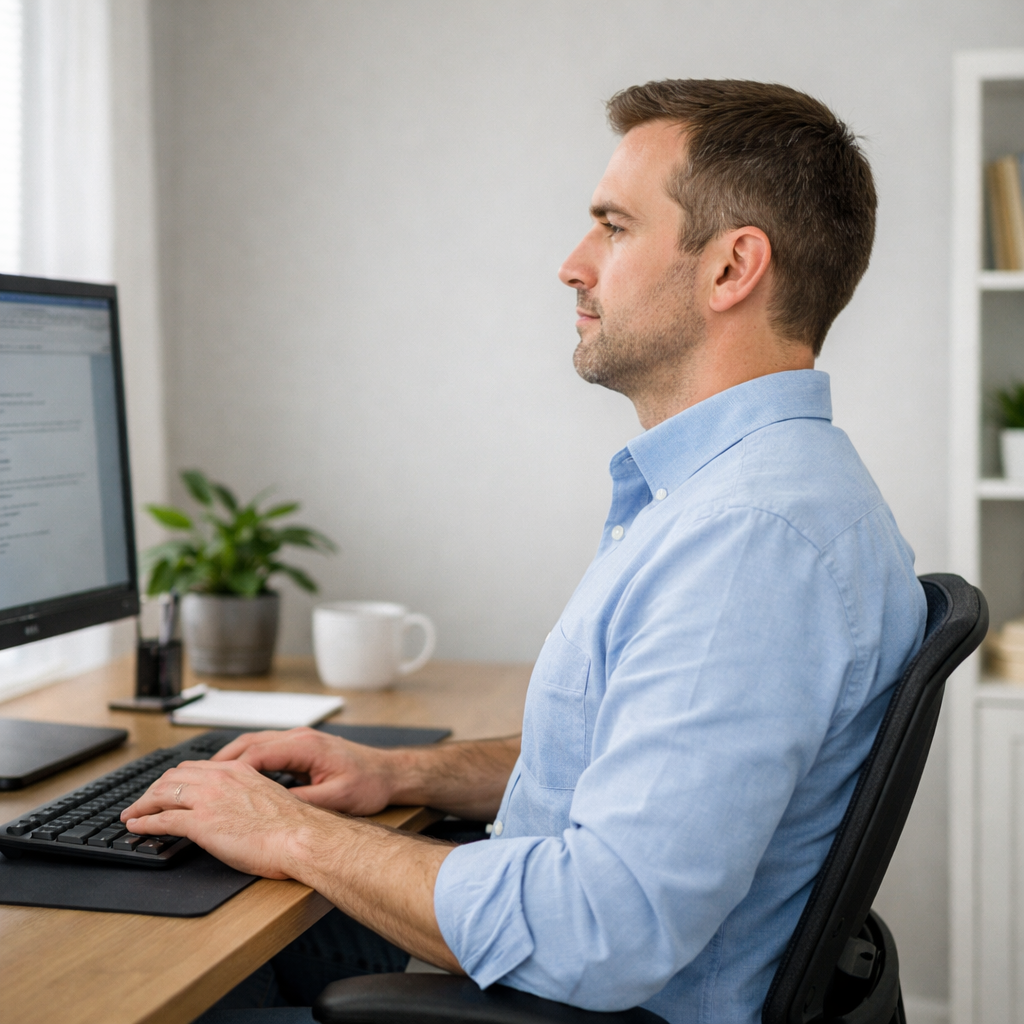 Your 8-Minute Desk + Driving Reset ✅
Use this when you notice forward head posture, rounded shoulders, or that “tight band” feeling across the upper back.
✅ Minute 1: Long exhale + ribcage down (calm the upper traps)
✅ Minutes 2–3: Chin tuck holds (deep neck flexors)
✅ Minutes 4–5: Chest opener stretch (pecs)
✅ Minutes 6–7: Upper back extension (thoracic spine)
✅ Minute 8: Scap squeeze endurance (mid-back)
📌 Best rule: do it once mid-day, then again after your commute if driving is a trigger.
Why Desk Time + Driving Create Forward Head Posture and Rounded Shoulders
A desk and a steering wheel both put you in the same pattern: hips flexed, ribs drifting up, shoulders creeping forward, and your head translating in front of your body. That is why “just stretch the neck” rarely lasts.
Here is the useful way to think about it:
Mobility problem: chest and upper back get stiff, so you borrow motion from the neck
Endurance problem: your mid-back and deep neck muscles fatigue, so your body chooses the easiest slouch
Setup problem: your screen or wheel position quietly trains the slump for hours
If you address only one of those, you often feel better for a day, then drift back into the same posture.
Quick Posture Self-Check (30 Seconds) 🧍
Stand naturally and use a mirror or your phone camera:
-
Can you see your ears lined up roughly over the middle of your shoulders?
-
Do your shoulders sit “wide” (not rolled forward)?
-
Does one shoulder or hip look noticeably higher?
If you keep noticing uneven shoulder height, rib shift, or a persistent lean, that is also a good time to review the early signs of scoliosis and posture checks so you know what is normal versus what deserves an evaluation.
Table 1: What you notice and the fastest fix
| What you notice | What it often means | Quick desk fix (1 min) | Quick driving fix (1 min) |
|---|---|---|---|
| Chin jutting forward | Deep neck muscles fatigue + screen too low | 5 gentle chin tuck holds (5 sec) | Head rest “touch test” (light contact) |
| Shoulders rounding | Tight pecs + weak mid-back endurance | Doorway chest opener + long exhale | Shoulder blades “down and back” for 5 breaths |
| Upper traps always tight | Ribs flared + breathing up high | Exhale longer than inhale (6–8 sec out) | Relax grip, drop shoulders, breathe low |
| Mid-back feels stiff | Thoracic extension limited | Back-of-chair thoracic extension | Tall posture at stoplight + ribcage down |
How to Set Up Your Desk and Car So the Routine Actually Works
This is the “why your stretches do not hold” section. If you do the exercises but your setup keeps forcing the same posture for 8 hours, your body will keep choosing the slump.
The 90-90-90 rule for sitting (simple version)
Aim for:
-
Hips ~90°, knees ~90°, ankles ~90°
-
Feet flat, sit bones on the chair (not perched on the edge)
-
Screen near eye level so your chin is not drifting down
For driving, bring the seat a little closer than you think: elbows slightly bent, ribs not flared, and headrest close enough that you can lightly “find it” without pushing your head back hard.
Desk Routine (6 Minutes) for Posture Stiffness
Do this once during the workday. If you only do one thing, do the first two parts.
1) Long exhale reset (45 seconds)
Sit tall, tongue on the roof of your mouth, and breathe out slowly like you are fogging a mirror. Feel the ribs come down slightly. This reduces the “shrugged” breathing pattern that feeds neck tension.
Tip: if your shoulders rise when you inhale, keep the inhale smaller and the exhale longer.
2) Chin tuck holds (90 seconds)
Keep your eyes level and glide your head straight back (like making a “double chin”), then relax. You should feel the front of the neck work lightly, not pain in the throat.
Do 6 rounds of: 5-second hold + 10-second rest.
Common mistake: looking down. The motion is straight back.
3) Doorway chest opener (60 seconds)
Place forearms on the doorway, step through gently, and think “sternum soft, ribs down.” This is one of the most effective posture stretches for rounded shoulders because it targets the tight pec position that pulls the shoulder forward.
Do 2 slow breaths, then shift slightly higher or lower and repeat.
4) Upper back extension on a chair (75 seconds)
Sit tall, hands behind head, and gently extend over the top of the chair back (mid-back), not the low back. Keep the chin slightly tucked so you do not crank the neck.
Do 5 slow reps, pausing for one breath at the top.
5) Scap squeeze endurance (90 seconds)
Squeeze shoulder blades down and back like you are putting them into your back pockets. Hold 2 seconds, relax 2 seconds, repeat.
Do 12 reps. You are building endurance, not max strength.
📌 Quick desk habit that makes all of this stick: every time you open a new browser tab, do one scap squeeze and one long exhale. That is enough to interrupt the slump without turning your day into a workout.
Driving Routine (2–4 Minutes) 🚗
Driving posture is tricky because you cannot “work out” while steering. This is about small inputs that reduce the forward head posture pattern.
Before you start the car (60 seconds)
-
Sit back so your pelvis is fully supported
-
Take 3 long exhales (ribs down)
-
Lightly find the headrest with the back of your head (do not jam)
At red lights or stop signs (90 seconds)
Without lifting your hands off the wheel, do:
-
Mini chin tuck (2 seconds) x 5
-
Shoulder blade set (2 seconds) x 5
-
One slow breath out between reps
After the drive (60 seconds)
Do the doorway chest opener again for 2 breaths per side. If you drive from Geist Indianapolis, Castleton, Carmel, or McCordsville into Fishers regularly, this one minute is often the difference between “fine today” and “tight all week.”
 Which Option Is Best: Stretching, Strengthening, or Getting Assessed?
 Which Option Is Best: Stretching, Strengthening, or Getting Assessed?
Most people try posture stretches first because they feel good immediately. The problem is that stretching alone often does not give your body the endurance to hold a better posture during real life.
Table 2: Choosing the best path
| Option | Best for | What it fixes | What it misses |
|---|---|---|---|
| Stretching-first | Feels tight, stiff, “stuck” | Mobility (pecs, upper back) | Endurance to hold changes |
| Strengthening-first | Feels weak, slouchy, fatigues fast | Control and endurance | Stiff joints that block posture |
| Combined plan (best for most) ✅ | Desk + driving patterns | Mobility + endurance + habit | Needs consistency for 2–4 weeks |
| Assessment + plan | Symptoms keep returning, pain spreads, numbness | Finds your specific limiter | Requires a visit and follow-through |
If you want the simplest answer: the combined plan is usually the best option because it changes both the “position you can reach” and the “position you can keep.”
How to Stop Slouching Without Thinking About It All Day
The real win is not perfect posture. It is fewer flare-ups and less “posture debt” at the end of the day.
Try these three cues for one week:
-
Phone cue: hold your phone higher so your chin does not drop
-
Keyboard cue: elbows near your sides, shoulders not creeping up
-
Drive cue: headrest touch test + long exhale at the first stoplight
Also consider sleep setup. If your pillow pushes your head forward, you start the day in the same forward head posture you are trying to fix. A neutral pillow height (neck supported, chin not tucked hard) matters more than fancy gear.
When Home Work Is Not Enough (Book Instead of Guessing)
 When Home Work Is Not Enough (Book Instead of Guessing)
If any of these are true, it is smart to get checked:
-
Neck pain or headaches keep recurring even when you are consistent
-
Numbness, tingling, or pain travels into the arm
-
You cannot comfortably turn your head while driving
-
One-sided symptoms keep showing up (same shoulder, same side of the neck)
If you want a clear next step, Vital Connection Chiropractic’s new patient visit includes posture and balance assessment as part of their intake process.
You can schedule an appointment and bring your questions so your plan matches your exact pattern.
Next Steps in Fishers (Hub + Location + Schedule) ✅
✅ Start with the hub page: chiropractic care in Fishers, IN
✅ Nearby location pages: chiropractor near Noblesville, IN, chiropractor Carmel, IN, chiropractor near Castleton, IN, chiropractor near McCordsville, IN
✅ Ready now: schedule an appointment
Wrap-Up: posture correction exercises
If you keep this routine simple and repeatable, you will usually notice the biggest change in how your neck and shoulders feel during desk work and after driving. Aim for consistency over intensity, fix one setup issue, and let your endurance catch up over the next few weeks.
FAQs
Can I correct years of bad posture?
Yes, you can improve posture even after years, but it works best when you treat it like building stamina, not chasing a perfect position. Most people need a mix of upper back mobility, chest opening, and deep neck plus mid-back endurance so the new posture becomes your default. Expect the first wins to be “less tight at the end of the day,” then better comfort while driving, then longer stretches of good posture without thinking.
What is the best exercise to correct your posture?
The best single exercise is usually a controlled chin tuck with a long exhale, because it targets forward head posture while calming the rib flare and shoulder shrug pattern that keeps the neck overloaded. The key is doing it gently and often enough to build endurance. Pair it with one upper back movement (thoracic extension) and you get a bigger carryover to desk and driving posture than stretching alone.
What is the best sleeping position for posture?
Back or side sleeping with the neck in a neutral line is usually best, meaning your pillow supports the curve of your neck without pushing your chin forward or cranking your head sideways. Stomach sleeping often forces the neck into rotation for hours, which can add to morning stiffness. If you are a side sleeper, a pillow between the knees can also reduce twisting through the spine and help you wake up less “crooked.”
How do I stop slouching?
You stop slouching by changing the trigger, not by trying harder, because willpower fades after about 20 minutes of screen time. Pick one cue you will actually repeat: raise your screen, do one long exhale when you open a new tab, or use the headrest touch test in the car. When your setup supports you and you build mid-back endurance, slouching becomes less automatic, even on busy days.
Is it possible to reverse slouching?
In many cases, yes, slouching can be reduced significantly, especially when it is driven by habits and muscle endurance rather than a fixed structural limitation. The fastest progress usually comes from restoring chest and upper back mobility, then building endurance in the mid-back so your shoulders stop drifting forward. If the curve is rigid, painful, or paired with noticeable asymmetry, that is when an assessment helps clarify what can change and what needs a different approach.
What is the 90-90-90 rule for sitting?
The 90-90-90 rule means hips, knees, and ankles are each around 90 degrees, with feet flat and your pelvis supported by the chair, not perched forward. This setup reduces the “hip flexor and low back grip” that contributes to rib flare and shoulder rounding. It is not about sitting perfectly all day; it is about starting from a position that does not force your head forward. Adjust your seat height, bring the screen up, and let your elbows rest comfortably.