

TMJ Ear Pain in Fishers, IN: Why Your Jaw Can Make Your Ear Hurt
TMJ ear pain is ear discomfort, pressure, fullness, or aching that starts from irritation in the jaw joint and surrounding muscles instead of from an ear infection. Because the temporomandibular joint sits close to the ear and shares nearby muscles and nerve pathways, TMJ problems can make your ear hurt, feel blocked, click, or seem irritated even when the main source is your jaw.
Many people in Fishers, IN are surprised when ear pain turns out to be connected to clenching, jaw tension, chewing strain, or neck stiffness rather than a true ear problem. That confusion is common because ear pain can be “referred,” meaning the pain is felt in the ear even though the source is somewhere nearby, including the temporomandibular joint. When the ear itself looks normal, clinicians often consider sources such as TMJ, dental issues, throat problems, or cervical spine pain.
If you have TMJ ear pain, the next step is not guessing. A proper evaluation is important so the problem is not mistaken for an ear infection, sinus issue, or dental problem. The good news is that many TMJ related symptoms improve with conservative care, habit changes, and a plan that addresses jaw strain and nearby muscle tension.
What TMJ Ear Pain Usually Feels Like
TMJ ear pain does not always feel the same from person to person. Some people notice a dull ache just in front of the ear. Others describe pressure, fullness, clicking, popping, tenderness with chewing, or pain that spreads into the temple, face, jaw, or neck. Ringing in the ears, dizziness, and changes in how the teeth meet can also happen with temporomandibular disorders.
Common signs that jaw dysfunction may be part of the picture include:
- Ear pain that gets worse when chewing, yawning, or talking a lot
- Jaw soreness in the morning
- Clicking or popping that is painful
- Tightness in the cheeks or temples
- A sense of jaw fatigue after eating chewy foods
- Headaches that come with jaw tension
- Jaw pain and ear pressure on the same side
When those symptoms show up together, it raises suspicion that the ear pain may be linked to the jaw rather than the ear canal itself.
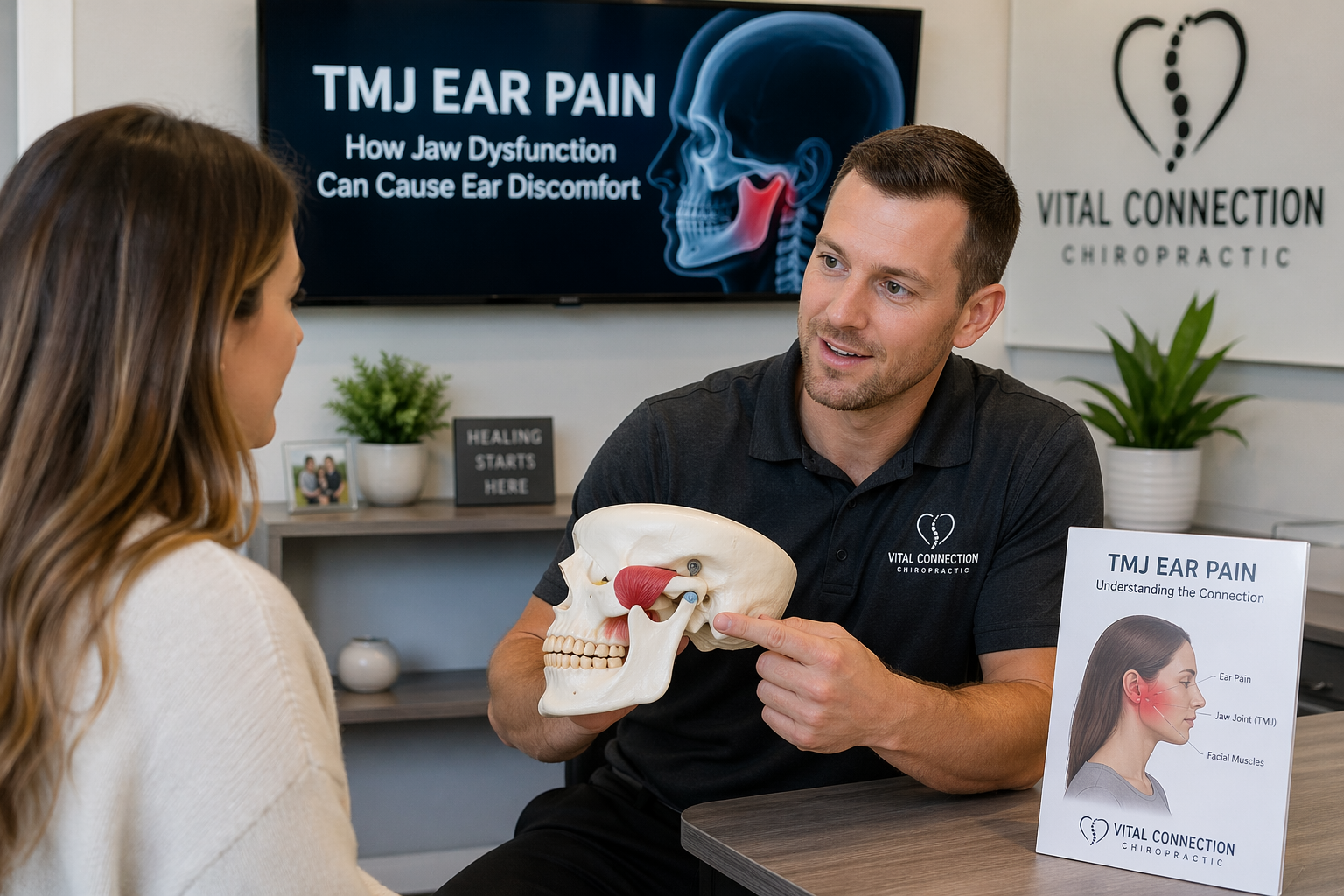 Why the Jaw Can Cause Ear Pain
The TMJ sits just in front of the ear. When the joint or the chewing muscles become irritated, inflamed, overworked, or restricted, the pain can feel like it is coming from the ear. This is one reason people with TMJ ear pain often say, “My ear hurts, but nothing seems wrong with it.”
The discomfort may build from:
- Teeth grinding or clenching
- Stress related jaw tension
- Chewing gum often
- Tough or chewy foods
- Poor head and neck posture
- Jaw overuse from wide yawning or long dental visits
- Previous trauma or strain to the jaw and neck
Cleveland Clinic notes that habits such as chewing on objects, poor posture, large bites of food, and daytime clenching can aggravate TMD symptoms. That matters because jaw mechanics and neck posture often work together. In practice, people who spend long hours on phones or computers may develop both neck tension and jaw tension, which can make TMJ ear pain harder to ignore.
| Symptom pattern | What it may suggest |
|---|---|
| Ear ache or pressure that increases with chewing | Jaw joint or chewing muscle irritation |
| Morning jaw soreness or headache | Nighttime clenching or grinding |
| Painful popping or clicking near the ear | TMJ irritation with jaw movement |
| Ear pain with a normal ear exam | Referred pain from TMJ, teeth, throat, or neck |
| Jaw tightness plus temple or cheek pain | Overworked chewing muscles |
This table is not a diagnosis tool, but it shows why TMJ causing ear pain is often confused with a primary ear condition. Referred ear pain is well recognized in medical evaluation, and TMJ is one of the common secondary sources.
What Can Make TMJ Ear Pain Worse
TMJ ear pain often flares for a reason. In many cases, the pain is not random. It tends to worsen when the jaw is overloaded or when nearby muscles stay tense for too long.
Common aggravators include chewing gum, eating bagels or jerky, clenching during stress, sleeping in a position that compresses the jaw, holding the phone between the shoulder and ear, and forward head posture at a desk. Even frequent throat clearing or nail biting can add extra work to the jaw muscles.
This matters for people around Fishers, Noblesville, Carmel, and surrounding Hamilton County communities because many flare ups are tied to normal daily habits, not just one major injury. A person may not notice how often they tense their jaw until the ear pressure or aching becomes more persistent.
You can learn more about related symptoms and care options on our TMJ condition page.
 How to Relieve Ear Pain Caused by TMJ
 How to Relieve Ear Pain Caused by TMJ
For many people, early relief starts with reducing irritation and calming the muscles around the jaw. Mayo Clinic recommends avoiding overuse of the jaw muscles, choosing softer foods, cutting food into smaller pieces, avoiding gum, and using gentle stretching or massage guided by a qualified professional.
Helpful self care steps may include:
- Eat softer foods for a few days
Choose foods that do not require aggressive chewing. - Stop chewing gum and avoid hard snacks
This reduces repeated jaw loading. - Use warm, moist heat when the area feels tight
Heat may help relax tense muscles. Cleveland Clinic notes warm, moist compresses can help chronic TMJ pain. - Notice daytime clenching
Many people lightly clench without realizing it. Resting posture should be lips together, teeth apart, tongue resting gently on the roof of the mouth. - Limit very wide mouth opening
Big yawns, oversized sandwiches, and jaw stretching done too aggressively can irritate symptoms. - Improve workstation posture
Jaw pain and neck strain often travel together. - Get evaluated if symptoms keep returning
Recurrent TMJ ear pain often needs a more specific plan than home care alone.
If your symptoms are recurring, painful, or limiting daily life, schedule appointment to have the jaw, neck, posture, and surrounding soft tissues evaluated together.
When TMJ Ear Pain Needs a Closer Look
Not every ear ache is TMJ. That is why a proper evaluation matters. Primary ear pain can come from conditions like otitis media or otitis externa, while secondary ear pain may come from the TMJ, dental structures, throat, or cervical spine.
An ENT can be helpful when there is concern that the ear itself may be involved. An otolaryngologist can examine the ear, nose, and throat, rule out primary ear disease, and help identify whether the pain is being referred from somewhere else. Primary care sources emphasize ear inspection and otoscopic examination as part of sorting out ear pain.
Symptoms that deserve medical attention sooner include:
- Sudden hearing loss
- Ear drainage
- Fever
- Significant swelling
- Trauma
- Inability to open or close the jaw normally
- Constant or worsening pain that does not settle
Mayo Clinic advises seeking care if you have constant jaw pain or tenderness or if you cannot open or close your jaw completely.
| Situation | Best next step |
|---|---|
| Mild TMJ ear pain after chewing, clenching, or stress | Rest the jaw, use softer foods, reduce gum and clenching, monitor symptoms |
| Recurrent jaw pain and ear pressure with clicking or stiffness | Schedule a clinical evaluation of the jaw, neck, and related mechanics |
| Ear pain with a normal ear check but ongoing symptoms | Consider evaluation for TMJ, dental, throat, or cervical causes |
| Ear drainage, fever, sudden hearing changes, or significant swelling | Seek prompt medical assessment |
| Jaw locks open or closed, or opening is very limited | Seek timely professional evaluation |
This is one reason people with TMJ causing ear pain often benefit from a team mindset. Sometimes the best answer is conservative jaw care. Other times the right step is an ear check, dental exam, or both.
What a Conservative TMJ Evaluation May Include
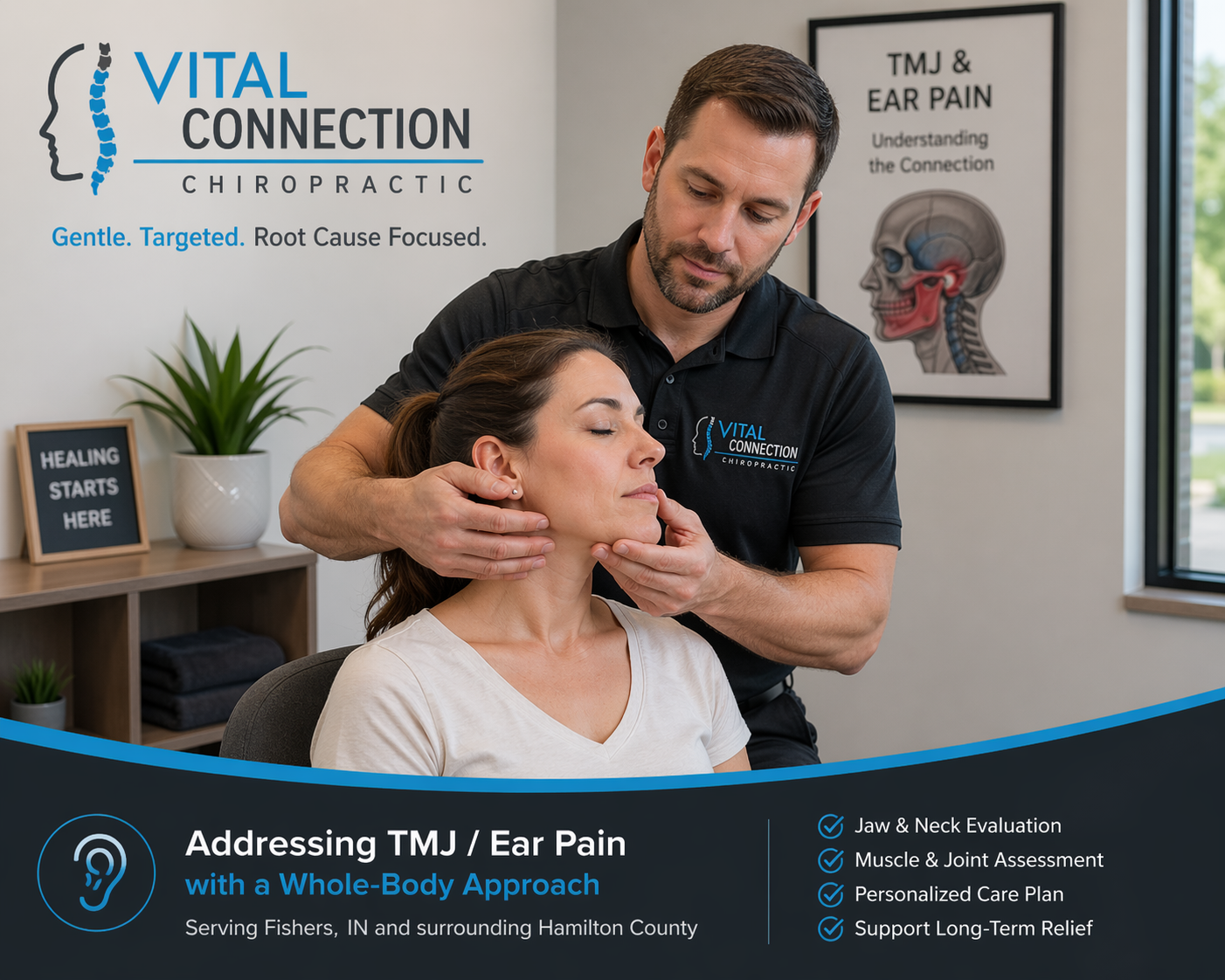 What a Conservative TMJ Evaluation May Include
At Vital Connection Chiropractic, a conservative musculoskeletal evaluation for TMJ ear pain may look at more than the jaw joint alone. Because the jaw, neck, posture, and surrounding muscles often influence one another, an exam may include:
- Jaw opening and closing pattern
- Pain with chewing or talking
- Tenderness in the cheeks, temples, and jaw muscles
- Neck mobility and muscle tension
- Posture habits
- Clenching or grinding history
- Whether symptoms are one sided or both sides
- Whether the pain behaves like a joint problem, muscle problem, or referred pain pattern
NIDCR notes there is no single widely accepted standard test for TMD, which is why history and physical findings matter. A careful evaluation helps decide whether conservative care is reasonable or whether another referral is more appropriate.
For patients in Fishers, IN, the goal is not just temporary relief. The goal is to understand what may be driving the jaw pain and ear pressure so daily habits, posture, and movement patterns can be addressed in a practical way. Individualized care matters because TMJ symptoms do not behave the same in every patient.
If you are unsure whether your symptoms sound like TMJ, contact us for guidance on the next step.
Is TMJ Ear Pain Temporary or Chronic?
TMJ ear pain can be short term, recurring, or chronic. NIDCR states that many TMDs last only a short time and go away on their own, but some become chronic. Cleveland Clinic also notes that some people feel better within a week or two while others need ongoing care.
That means the answer depends on the cause.
A short flare may happen after heavy chewing, travel stress, a rough night of clenching, or poor sleep posture. A longer pattern may stick around when underlying contributors keep repeating, such as untreated grinding, persistent neck tension, or ongoing jaw overload. Mayo Clinic also notes that symptoms sometimes go away without treatment, while persistent symptoms may need more than one conservative approach at the same time.
If TMJ ear pain has become a pattern, it is worth addressing before the body starts adapting around it. People often change how they chew, talk, sleep, or hold their head because of discomfort. Over time, that can keep the cycle going.
You can also review our TMJ treatment information if you want a clearer picture of how jaw symptoms may connect with the neck and surrounding muscles.
A Simple Screening Clue: The 3 Finger Test
The 3 finger test is a quick screening method used to estimate how wide you can open your mouth. Cleveland Clinic explains it in relation to trismus. If a person cannot fit three stacked fingers vertically between the front teeth, it may suggest restricted opening. But it is not a diagnosis by itself, and it does not prove that TMJ is the cause.
That is important because some people with TMJ ear pain have normal mouth opening, while others feel pain, deviation, or tightness only at certain points in motion. The test is useful as a clue, not as a final answer.
The Local Takeaway for Fishers, IN Patients
TMJ ear pain is real, common, and often misunderstood. The discomfort may feel like an ear problem, but the jaw, chewing muscles, neck, and posture may be the real drivers. When the pain keeps returning, the smartest move is not to keep guessing. It is to get the area evaluated carefully so the cause can be narrowed down and red flags can be ruled out.
For people in Fishers, Noblesville, Carmel, Geist, McCordsville, and nearby communities, early conservative care may help reduce irritation, improve jaw mechanics, and support better day to day comfort depending on the cause. If TMJ ear pain is affecting eating, talking, work, or sleep, schedule your visit so the problem can be looked at before it becomes a bigger pattern.
FAQ
How to relieve ear pain caused by TMJ?
Start by reducing jaw irritation. Softer foods, avoiding gum, limiting very wide mouth opening, using warm moist heat, and paying attention to clenching may help. If the pain keeps returning or affects chewing, talking, or sleep, a proper evaluation is important so the problem is not mistaken for an ear or dental issue.
What is the 3 finger test for TMJ?
The 3 finger test is a quick screen for mouth opening. If you cannot fit three stacked fingers between your front teeth, it may suggest limited opening. It can be helpful as a clue, but it is not a stand alone TMJ diagnosis.
Is TMJ a chronic illness?
TMJ disorders can be temporary or chronic. NIDCR says many cases are short lived and may settle on their own, but some become long lasting. That is why recurring symptoms should not be ignored.
What can an ENT do for TMJ?
An ENT can examine the ear, nose, and throat, rule out primary ear disease, and help determine whether the pain is being referred from the jaw, throat, or another nearby source. That can be especially helpful when the symptoms are not clearly coming from the ear alone.
What is commonly misdiagnosed as TMJ?
Several problems can overlap with TMJ symptoms, including primary ear conditions, dental problems, pharyngitis or throat related pain, and cervical spine issues. In the other direction, TMJ may also be mistaken for an ear infection because the pain is felt so close to the ear.
How long does TMJ ear pain last?
It varies. Some people improve within days or a couple of weeks, while others have a recurring or chronic pattern. The duration often depends on what is driving the symptoms and whether aggravating habits keep repeating.
Related Posts:
 Can a Chiropractor for Scoliosis Help? Realistic Results, Limits, and Next Steps
 Treatment for TMJ in Fishers, IN: Symptoms, Causes, and What May Help
 How to Cure TMJ Permanently in Fishers, IN: What Actually Helps Long Term
 How Do You Treat TMJ Dysfunction in Fishers, IN? Conservative Relief Options That May Help