Neck Pain After Car Accident in Fishers, IN: What It Means and What To Do Next
Neck pain after car accident is commonly caused by whiplash, muscle strain, ligament irritation, joint stress, or inflammation in the neck after the head and body move suddenly during impact. Even if the crash seemed minor, car accident neck pain can appear right away or build over the next several hours or days. The safest next step is to monitor symptoms closely, avoid aggressive stretching, and get evaluated if pain, stiffness, headaches, dizziness, numbness, or limited motion develops.
Why Neck Pain Happens After a Car Accident
Neck pain after a car accident often happens because the body absorbs force faster than the muscles and joints can control. In a rear-end collision, side-impact crash, or sudden stop, your head may move forward, backward, or sideways while your torso is restrained by the seat belt. This quick movement can strain the soft tissues around the cervical spine.
The neck is designed to move, but it is also sensitive. It contains small joints, discs, muscles, ligaments, nerves, and connective tissue that all work together. When an accident places sudden stress on these structures, discomfort may follow.
Common causes of car accident neck pain include:
- Whiplash or neck strain
- Tight or irritated neck muscles
- Ligament sprain
- Joint inflammation
- Disc irritation
- Nerve irritation
- Poor posture after the accident due to guarding
- Headaches related to neck tension
Not every case of neck pain after auto accident trauma is severe, but it should be taken seriously. Some people feel sore for a few days, while others notice symptoms that linger and interfere with sleep, driving, work, or daily routines.
If your symptoms feel familiar to whiplash, the Whiplash page can help you understand the condition more clearly.
 Common Symptoms To Watch For
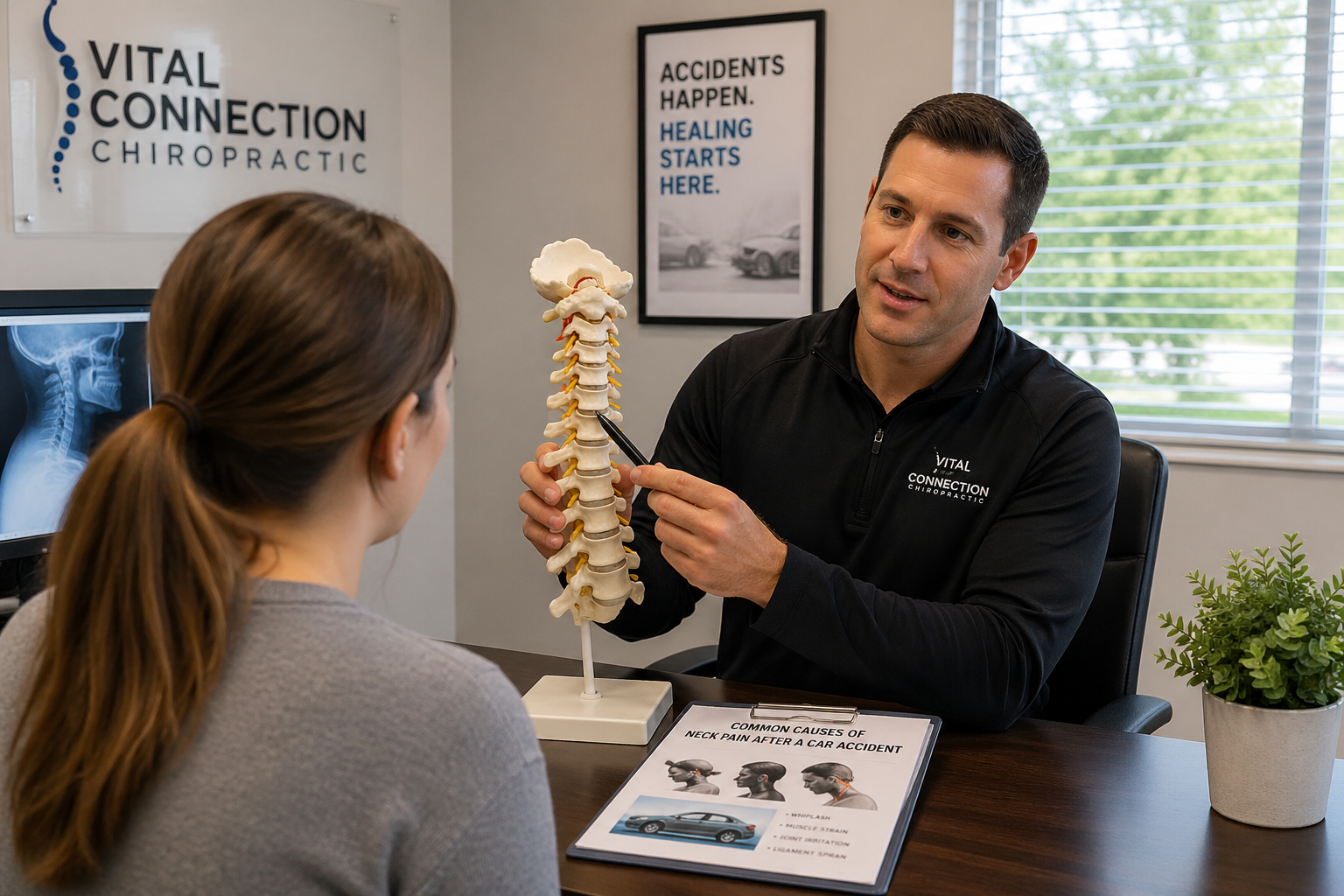
Neck pain after a car crash can feel different from person to person. Some patients describe sharp pain when turning their head. Others feel deep stiffness, tightness, or a heavy aching sensation across the neck and shoulders.
Common symptoms may include:
- Neck pain or soreness
- Neck stiffness
- Trouble turning the head
- Headaches, often near the base of the skull
- Shoulder or upper back pain
- Muscle spasms
- Tenderness to touch
- Fatigue
- Jaw discomfort
- Dizziness
- Tingling or numbness in the arm or hand
- Trouble sleeping because of neck discomfort
Symptoms like numbness, tingling, weakness, severe headache, confusion, vision changes, fainting, or worsening pain should be evaluated promptly by a medical professional. These signs may point to nerve involvement, concussion-related concerns, or a more serious injury that needs medical care.
Table 1: What Neck Pain After a Car Accident May Mean
| Concern | What It May Mean | Best Next Step |
|---|---|---|
| Mild soreness and stiffness | Muscle strain or soft tissue irritation | Rest briefly, use gentle movement, and monitor symptoms |
| Headache with neck tightness | Neck-related tension or whiplash irritation | Schedule an evaluation if it does not improve |
| Pain when turning the head | Joint restriction, muscle guarding, or inflammation | Avoid forcing motion and get checked |
| Tingling or numbness in the arm | Possible nerve irritation | Seek professional evaluation promptly |
| Severe pain after impact | Possible significant injury | Consider urgent medical evaluation |
Why Pain Can Show Up Hours or Days Later
One of the most confusing parts of neck pain after car accident trauma is that symptoms may not appear immediately. After a crash, your body may release stress hormones that temporarily mask pain. You may feel “okay” at the scene, only to wake up the next morning with stiffness, soreness, or headaches.
Inflammation can also take time to build. Soft tissue injuries may become more noticeable as swelling, muscle guarding, and joint irritation increase. This is why a person can walk away from a crash and still develop neck pain later.
Delayed symptoms are common with whiplash-type injuries. For that reason, it is wise to pay attention to your body for several days after an accident, even if the crash seemed minor.
A good rule is this: if your neck pain is getting worse, limiting movement, affecting sleep, or spreading into the shoulders or arms, do not ignore it.
When Neck Pain May Be Whiplash
Whiplash is one of the most common reasons people experience neck pain after a car accident. It happens when the neck is forced to move quickly in a way that strains muscles, ligaments, joints, and other soft tissues.
Whiplash can happen in rear-end crashes, but it can also happen in side-impact collisions, sudden braking, sports injuries, and falls. The amount of vehicle damage does not always match the amount of body stress. A lower-speed accident may still irritate the neck if the head and torso move suddenly.
Signs your neck pain may be whiplash include:
- Stiffness that worsens over the first day or two
- Pain at the base of the skull
- Headaches after the crash
- Pain with looking up, down, or over the shoulder
- Shoulder or upper back tightness
- Muscle spasms
- Dizziness or fatigue
- Symptoms that appear later instead of immediately
Whiplash recovery varies. Mild cases may improve within days or a few weeks. More irritated cases can take several weeks or longer, especially if the person keeps straining the area or delays care.
What To Do First After Auto Accident Neck Pain
The first priority after any auto accident is safety. If there are serious symptoms, visible injury, loss of consciousness, severe headache, chest pain, confusion, weakness, or numbness, emergency medical care is important.
For less severe neck pain after auto accident trauma, these steps may help you avoid making symptoms worse:
- Document your symptoms. Write down when the pain started, where it hurts, and whether it is improving or worsening.
- Avoid forcing your neck. Gentle movement is usually better than aggressive stretching.
- Use cold therapy early. A cold pack may help calm soreness and swelling during the early phase.
- Watch for delayed symptoms. Headaches, stiffness, dizziness, or arm symptoms may show up later.
- Schedule a professional evaluation. An exam can help identify whether your pain is likely muscular, joint-related, whiplash-related, or something that needs medical referral.
If your neck pain is affecting your daily activities, the Neck Pain page can help you learn more about possible causes and care options.
 What Not To Do With Whiplash
 What Not To Do With Whiplash
When your neck hurts after a crash, it is natural to want fast relief. However, some common reactions can irritate the neck more.
Avoid these mistakes:
- Do not force deep neck stretches
- Do not crack or twist your own neck
- Do not return to heavy lifting too quickly
- Do not ignore worsening symptoms
- Do not stay completely inactive for too long unless directed by a provider
- Do not sleep in awkward positions that twist the neck
- Do not assume pain will disappear just because the crash was minor
Gentle motion, good posture, and proper evaluation are usually safer than aggressive self-treatment. Whiplash is often a soft tissue injury, and irritated tissues need the right balance of rest, movement, and guided care.
Table 2: Helpful Steps vs. Risky Moves After Neck Pain From a Crash
| Helpful Step | Why It May Help | Risky Move To Avoid |
|---|---|---|
| Gentle range of motion | Helps reduce stiffness without forcing the neck | Aggressive stretching |
| Cold pack in the early phase | May calm swelling and soreness | Heat too soon if swelling is active |
| Supportive sleeping position | Reduces added stress overnight | Sleeping with the neck twisted |
| Professional evaluation | Helps identify the likely source of pain | Guessing or self-diagnosing |
| Gradual return to activity | Supports mobility while respecting symptoms | Heavy lifting too soon |
How Chiropractic Care May Support Recovery
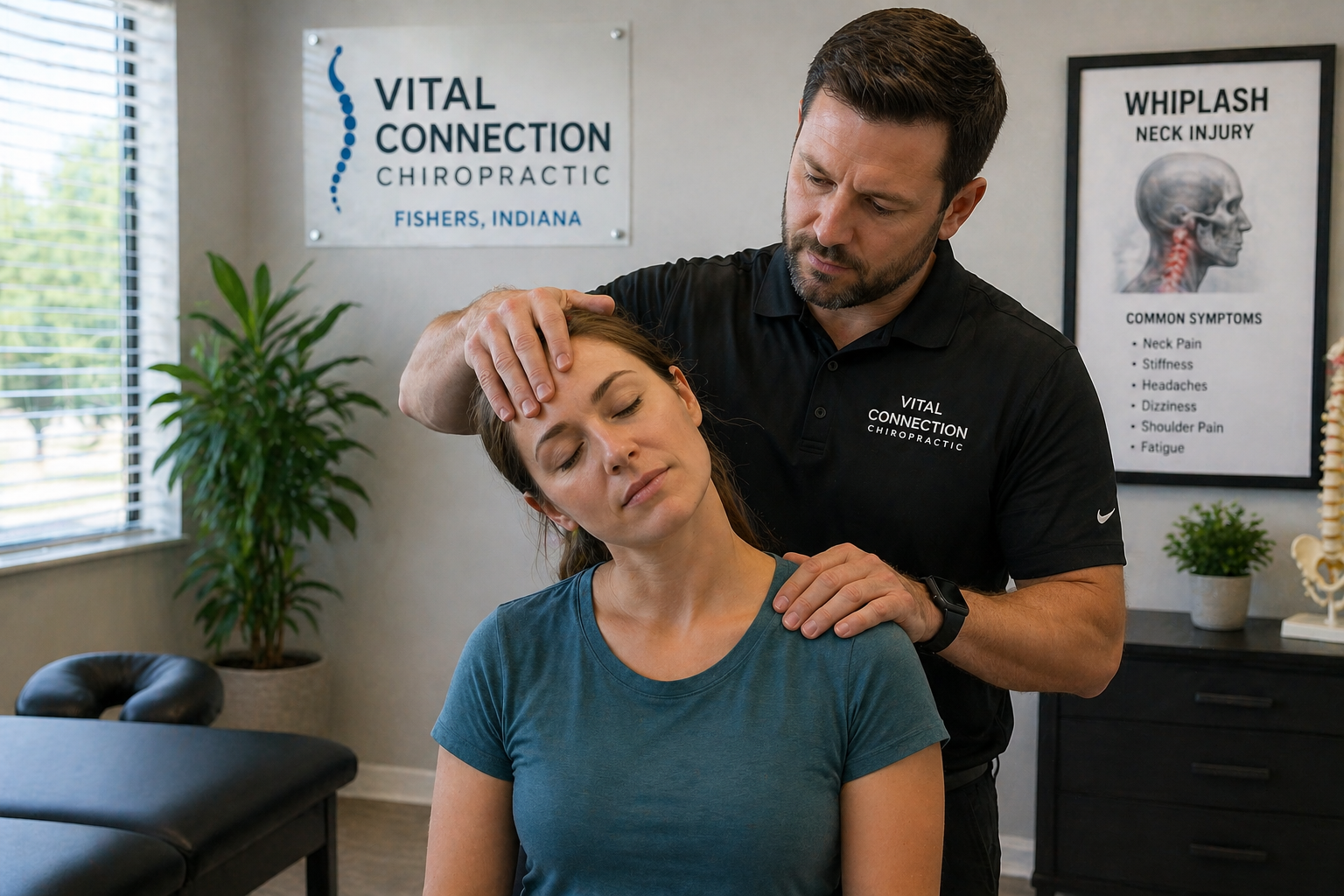
Chiropractic care may help some patients with neck pain after a car accident by improving joint motion, reducing muscle tension, supporting posture, and helping the body move more comfortably. Care should always be based on an evaluation and tailored to the patient’s symptoms, history, and injury pattern.
At Vital Connection Chiropractic in Fishers, care may include a combination of:
- Consultation and history review
- Neck and spine evaluation
- Range of motion checks
- Posture and movement assessment
- Gentle chiropractic adjustments when appropriate
- Soft tissue support
- Home care guidance
- Ergonomic and sleeping position recommendations
- Referral for medical imaging or additional care when needed
The goal is not to rush the process or make broad promises. The goal is to understand what is irritated, what movements are limited, and what type of care may be appropriate.
Some patients need gentle care at first because the neck is too sensitive for stronger approaches. Others may need a plan that includes gradual mobility work and posture correction after the initial soreness calms down.
If you are unsure whether your symptoms need attention, you can use Contact Us to ask the office about next steps.
Neck Pain After Car Accident in Fishers, IN
 Neck Pain After Car Accident in Fishers, IN
Fishers drivers often spend time on busy roads like I-69, 116th Street, Allisonville Road, and routes connecting Noblesville, Carmel, Geist, McCordsville, and Hamilton County. Even a quick stop-and-go collision can create enough force to irritate the neck.
For local patients, the challenge is often getting back to normal routines. Neck pain after a car accident can make it harder to drive, sit at a desk, lift children, sleep comfortably, work out, or focus at work.
A local evaluation can help you understand whether your pain appears to be minor soreness, whiplash-related irritation, or something that needs further medical attention. It can also help you avoid the cycle of waiting too long, moving poorly, and letting stiffness become harder to calm.
Vital Connection Chiropractic is located in Fishers, IN and works with patients who want clear guidance, practical care, and a plan that fits their situation.
To get evaluated, visit Schedule Appointment.
When To Schedule an Evaluation
You should consider scheduling an evaluation if your neck pain after a car accident lasts more than a few days, gets worse, limits movement, causes headaches, affects sleep, or spreads into the shoulders, upper back, arms, or hands.
You should seek urgent medical care if you have:
- Severe or worsening pain
- Numbness, tingling, or weakness
- Loss of balance
- Confusion
- Vision changes
- Fainting or loss of consciousness
- Trouble speaking or swallowing
- Severe headache after impact
- Pain after a high-force crash
For non-emergency symptoms, a chiropractic evaluation may help determine what type of care is appropriate and whether referral is needed. You can also revisit the Whiplash resource if your symptoms match a whiplash pattern.
A Patient-Friendly Recovery Mindset
Neck pain after a car accident can be frustrating because it may interrupt your routine before you fully understand what happened. Some people feel better quickly. Others need more time, guided care, and lifestyle adjustments.
A helpful recovery mindset includes:
- Taking symptoms seriously without panicking
- Getting evaluated when pain lingers or worsens
- Avoiding aggressive self-treatment
- Staying gently mobile when appropriate
- Following a care plan consistently
- Watching for nerve-related or concussion-related symptoms
- Asking questions so you understand your options
Healing often depends on the cause of the pain, the severity of the injury, your health history, and how early the issue is addressed. Chiropractic care may be part of a helpful recovery plan for some patients, but it should not replace emergency care or medical evaluation when red flags are present.
If your neck still feels stiff, sore, or limited after a crash, Schedule Appointment with Vital Connection Chiropractic in Fishers, IN.
FAQs
How long does pain last after a car accident?
Pain after a car accident can last a few days, several weeks, or longer depending on the injury. Mild muscle soreness may improve within days, while whiplash, joint irritation, or nerve-related symptoms may take several weeks or months. Pain that worsens, spreads, causes numbness, or affects daily life should be evaluated. A proper exam can help determine whether the pain is simple soreness or a sign of a more involved injury.
How long does a sore neck last after a car crash?
A sore neck after a car crash may last a few days to a few weeks, but the timeline varies. If the soreness is mild and improving, it may calm down with gentle movement, rest, and supportive care. If the neck becomes stiffer, headaches develop, or motion becomes limited, whiplash or deeper soft tissue irritation may be involved. Ongoing symptoms should be checked rather than ignored.
How long does whiplash last?
Whiplash can last from several days to several weeks, and some cases can take months. Mild whiplash often improves faster, especially when addressed early and not aggravated by poor posture, heavy lifting, or aggressive stretching. More severe cases may involve ongoing stiffness, headaches, or nerve symptoms. Because recovery depends on the person and injury severity, an individualized evaluation is the best way to understand what to expect.
What not to do with whiplash?
Do not force your neck, crack it yourself, ignore worsening symptoms, or return to heavy activity too quickly. Whiplash involves irritated soft tissues, and aggressive movement can make symptoms worse. It is also best not to stay completely inactive for too long unless a provider tells you to. Gentle movement, proper support, and professional guidance are safer than guessing. Seek care quickly if numbness, weakness, dizziness, or severe pain appears.
What are the 4 phases of whiplash?
The 4 phases of whiplash are often described as the initial injury phase, acute inflammation phase, repair phase, and remodeling or recovery phase. In the beginning, the neck absorbs sudden force. Then inflammation and stiffness may increase. As the tissues start to repair, movement may slowly improve. The final phase focuses on restoring better function, posture, and mobility. The exact timeline is different for each patient.
Can I fix mild whiplash in a day?
Mild whiplash usually cannot be fully fixed in one day, but symptoms may begin improving quickly with the right steps. The neck tissues still need time to calm down and recover. Gentle movement, avoiding strain, supportive posture, and proper evaluation can help guide recovery. Be careful with any promise of instant correction. If pain is severe, worsening, or includes nerve symptoms, seek professional care promptly.